Basement Finishing Contractor Licenses, Permits, and Insurance in Missouri: What St. Louis Homeowners Should Verify
You have picked your contractor, or you are close to it. Before you sign anything or hand over a deposit, spend one afternoon verifying three things: basement finishing contractor licenses, the permits your project will need, and the insurance that protects your house while the work happens. When you need to verify contractor license in Missouri, start with this guide. This is not busywork. In Missouri, contractor licensing works differently than in states like California or Florida, and that difference catches a lot of St. Louis homeowners off guard. This guide walks through exactly what to check, in what order, and what the paperwork means for your budget.
If you are the kind of homeowner who wants the bottom line first, here it is: Missouri has no statewide general contractor license, so the checking falls on you and your local building department. The contractor's trade subcontractors, the electrician and the plumber, do carry state or local licenses you can verify. Permits are pulled through your municipality, and the permit trail is your best protection against a cheap quote that skips the work behind the walls.
Why Missouri Licensing Confuses Basement Finishing Customers
Missouri does not issue a statewide general contractor license for residential remodeling. That single fact explains most of the confusion homeowners run into when they search for basement finishing contractor licenses and find pages written for California, Massachusetts, or Minnesota, where state boards license remodelers directly.
In Missouri, licensing happens at two levels instead. First, specific trades are licensed: electricians and plumbers must hold licenses, and mechanical contractors who install basement heating typically need them as well, depending on the jurisdiction. Second, individual cities and counties register or license contractors who work within their boundaries. St. Louis City and St. Louis County each run their own contractor registration and business licensing, and many municipalities inside the county, places like Kirkwood, Maryland Heights, or Florissant, layer their own requirements on top.
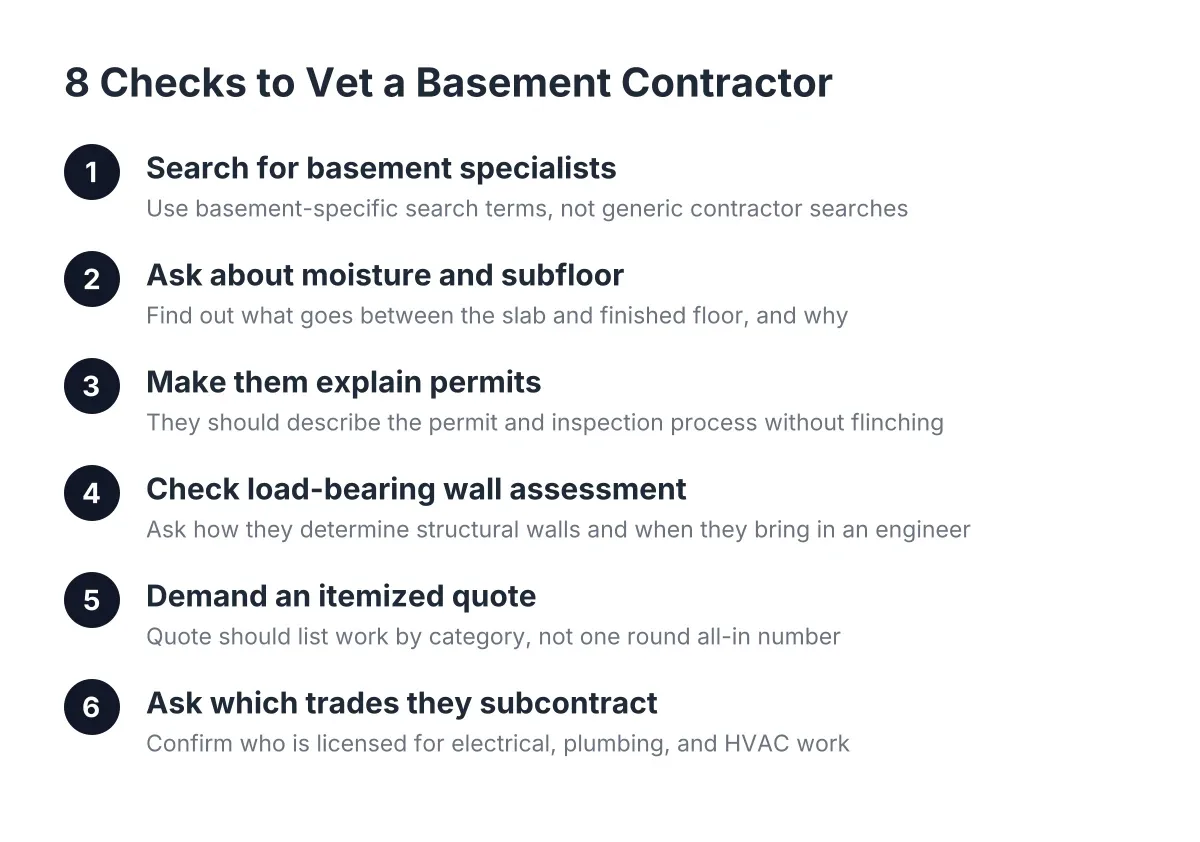
Therefore, when a contractor tells you "I'm licensed," your follow-up question matters: licensed where, and for what? A legitimate St. Louis basement finishing contractor should be able to tell you, without hesitation, which municipalities they are registered in and which licensed trades they bring in for electrical, plumbing, and HVAC work. If the answer is vague, that is your first warning sign.
How to Verify Contractor License for Missouri Basement Projects
For a typical basement finish with a bar or a basement bathroom, the license picture breaks down like this:
- The general contractor needs a business license or contractor registration in your specific municipality, plus whatever St. Louis County or City requires. There is no Missouri state license to check for the general remodeling work itself.
- The electrician wiring your outlets, lighting, and bar circuits must be licensed. Electrical work in a basement is inspected against the National Electrical Code, and inspectors check details most homeowners never see. For example, according to the National Electrical Code (NFPA 70), non-metallic sheathed cable, the Romex most people recognize, is not best practice for exposed conduit runs, and running it inside EMT conduit is against code in damp or wet locations. A basement is exactly where that rule bites.
- The plumber roughing in your basement bathroom must be licensed. Basement bathrooms often involve breaking the slab or installing an ejector pit, and that work gets inspected.
- The HVAC contractor extending ductwork or installing basement heating usually needs a mechanical license, depending on the municipality.
Notice the pattern. The trades that can burn your house down, flood it, or make it unsafe are the licensed ones. The framing, drywall, subfloor, and trim work rides on the contractor's local registration and, more importantly, on the permit and inspection process.
How to Verify Basement Finishing Contractor Licenses in St. Louis
Verifying basement finishing contractor licenses in St. Louis takes about an hour and costs nothing. You call or search the building department for your specific municipality, confirm the general contractor is registered to work there, and confirm the electrician and plumber on the job hold current trade licenses. Do this before signing, not after.
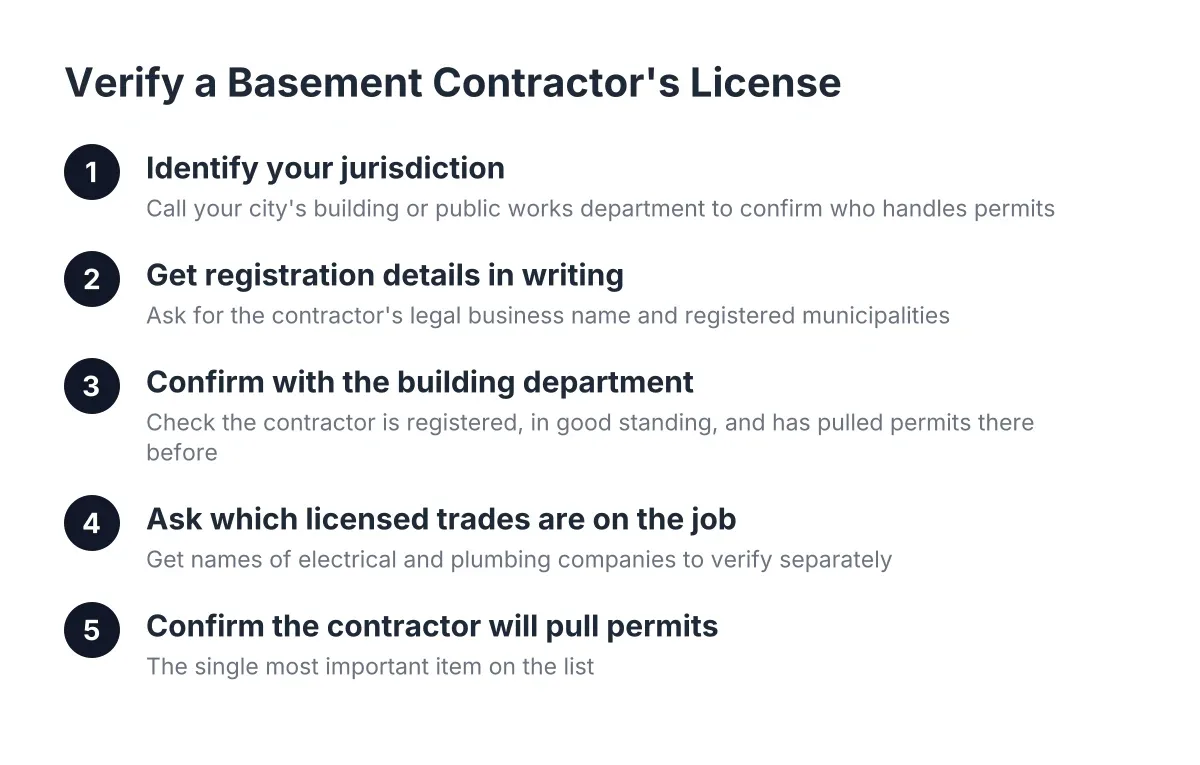
Here is the step-by-step version:
- Identify your jurisdiction. St. Louis City and St. Louis County are separate governments with separate rules. If you live in an incorporated municipality within the county, your city hall may handle permits and contractor registration itself, or it may defer to the county. One phone call to your city's building or public works department settles it.
- Ask the contractor for their registration details in writing. A legal business name and the municipalities where they are registered. You want this on paper or in an email, not over the phone.
- Confirm with the building department. Ask whether the contractor is registered and in good standing, and whether they have pulled permits in that jurisdiction before. A contractor who regularly pulls permits in your city is a contractor the inspectors already know.
- Ask which licensed trades will be on your job. Get the names of the electrical and plumbing companies. You can verify their licenses the same way.
- Confirm the contractor, not you, will pull the permits. This is the single most important item on the list, and the next section explains why.
In addition, ask for a certificate of insurance sent directly from the contractor's insurance agent. More on that below.
Do You Need a Permit to Finish a Basement in Missouri?
Yes. In St. Louis City, St. Louis County, and the municipalities within the county, finishing a basement requires a building permit, and the electrical, plumbing, and mechanical work each require their own permits and inspections. Cosmetic work like paint or carpet alone typically does not, but the moment you frame walls, run wiring, or add a basement bathroom, you are in permit territory.
Permit costs vary by municipality and by the declared value of the work, so no honest contractor can quote you an exact permit fee for every city. What you can count on is the process: plans get submitted, permits get issued, work gets inspected at defined stages, and a final inspection closes the project out.
For a basement finish, expect at least two separate inspections early in the process: an electrical rough-in inspection after the wiring is run but before drywall, and an insulation inspection after insulation goes in. Framing, plumbing rough-in, and mechanical inspections slot in around those, depending on your project scope. Each inspection is a checkpoint where a third party, the municipal inspector, confirms the work behind your future drywall was done right.
Why permits protect the budget-minded homeowner most of all
If you are watching every dollar, it is tempting to see permits as fees and delays. Flip that thinking. Permits are the cheapest quality control you will ever buy.
Suppose a homeowner in Affton gets two quotes for a 700 square foot basement finish with a half bath. Say one quote comes in thousands lower, and when pressed, that contractor mentions the job can go faster "without waiting on inspectors." In that scenario, the low price is not efficiency. It is the cost of skipping the electrical rough-in inspection, the plumbing inspection, and the accountability that comes with them. If that unpermitted bathroom leaks into the slab two years later, there is no inspection record, often no recourse, and a disclosure problem when the house sells.
As a result, the permit question doubles as a vetting question. A contractor who pulls permits in their own name is telling the city, on the record, that they stand behind the work. A contractor who asks you to pull the permits as a homeowner is shifting the legal responsibility for code compliance onto you while keeping the money. That arrangement should end the conversation.
Insurance: The Paperwork That Protects Your House, Not Theirs
Licensing and permits cover code compliance. Insurance covers everything that can go wrong while people are working in your basement. Before work starts, you want proof of two coverages.
General liability insurance pays if the contractor damages your property. A cut water line that floods your storage, a dropped beam that cracks the slab, damage to the finished floors upstairs while hauling material through the house. For a basement finish, ask about coverage limits and confirm the policy is active for your project dates.
Workers' compensation insurance covers the crew if someone gets hurt on your property. This one matters more than most homeowners realize. If an uninsured worker falls on your basement stairs, your homeowner's policy can end up in the crosshairs. Missouri requires workers' compensation for most construction employers, but crews built entirely from "independent" subcontractors sometimes fall through the cracks. Ask directly how the crew is covered.
However, do not accept a photocopy of an insurance card from the contractor's truck. Request a certificate of insurance sent to you directly from the insurance agent, with your name and project address listed. It takes the agent five minutes, it costs the contractor nothing, and it confirms the policy is real and current. Any professional will do this without friction. Anyone who stalls on it is telling you something.
What License and Permit Questions Reveal About a Quote
Here is where the paperwork connects to the number you actually care about: the price. When comparing basement finishing quotes in St. Louis, knowing how to verify contractor license and other requirements becomes a lie detector for the low bid. Every legitimate quote for a finished basement carries the same unavoidable costs: licensed electrical work, licensed plumbing for a basement bathroom, permit fees, and the labor of doing things in the sequence inspectors require. When one quote comes in far below the others, one of a few things is true. The scope is smaller than you think, the materials are thinner, or the licensed trades and permits are quietly missing from the number.
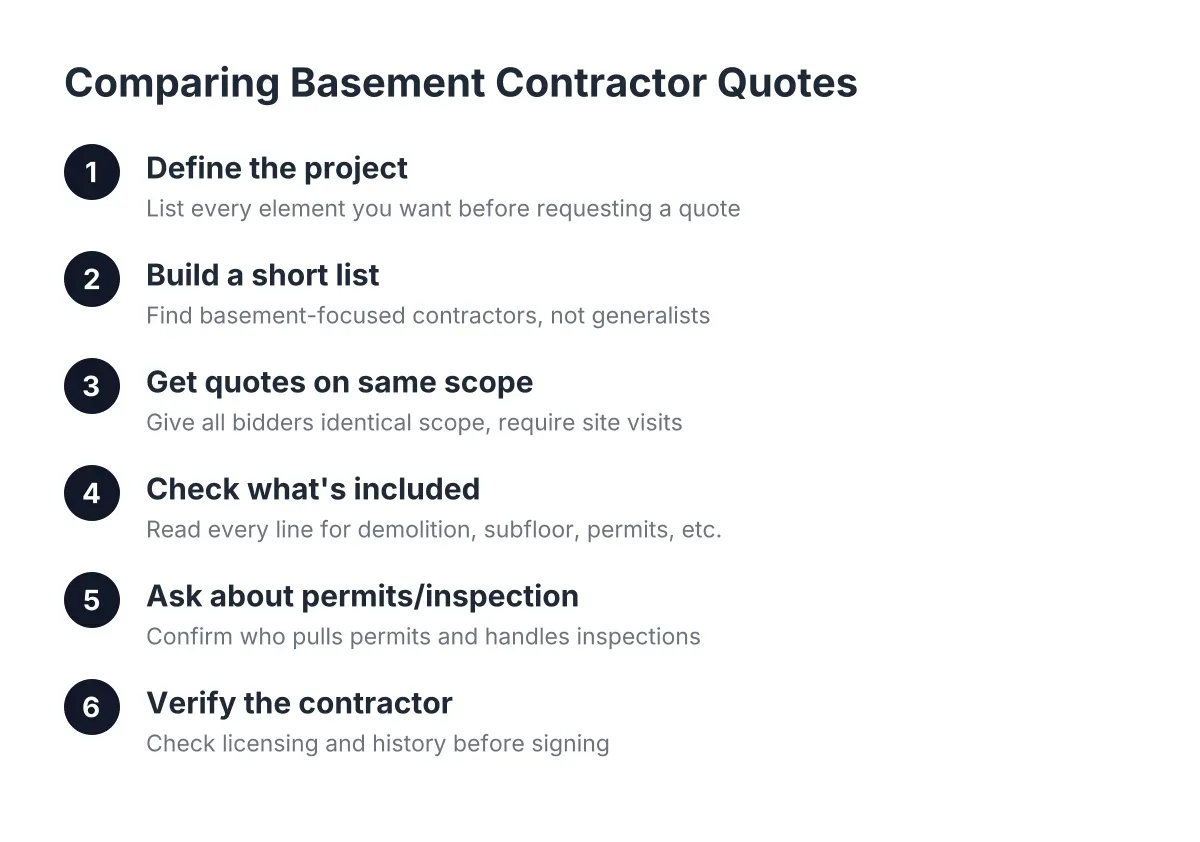
Therefore, ask every bidder the same short list and compare answers side by side:
- Who pulls the permits, and is the permit cost included in this quote?
- Which licensed electrician and plumber will work on my job?
- What inspections will happen, and at what stages?
- Is moisture addressed before framing, and how?
- What subfloor system is included, and why that one?
That last two questions deserve emphasis because they separate basement specialists from generalist remodelers who treat basements like a first floor that happens to be underground. Moisture management has to be resolved before insulation and framing go in; insulating over an unresolved water problem sets up hidden damage that surfaces after the drywall is painted and the check is cashed. Even in a basement with a vapor barrier under the slab, a proper subfloor system, often a plywood subfloor over a moisture-rated underlayment, adds protection for the finished space against future water events. According to W. R. Meadows, a vapor barrier placed under a concrete slab is meant to block moisture transmission from the ground into the concrete above; it does nothing about water that arrives from a plumbing failure or a wet spring, which is why the subfloor question still matters even in a "dry" basement.
A contractor who can explain that distinction over your kitchen table understands basements. A contractor who quotes carpet straight over concrete in a 40-year-old St. Louis house with a history of dampness is pricing a job that will not survive its first wet year.
When Basement Finishing Contractor Licenses Are Not Enough
Valid basement finishing contractor licenses, clean permits, and current insurance are the floor, not the ceiling. Two situations call for expertise beyond the standard checklist, and it is worth knowing them before you sign.
First, structural work. If your project involves removing or modifying a load-bearing wall, or cutting into the foundation for a new egress window, the framing plan matters as much as the license. Ask specifically how the contractor assesses load-bearing walls and what the framing plan looks like before demolition starts. In an already-finished area, adding structural reinforcement can mean tearing out existing framing to make room, then reframing and re-trimming around it, which affects both cost and schedule. A quote that does not account for that is a quote that will grow.
Second, active foundation problems. If your basement has ongoing water intrusion, visible foundation movement, or an inspection report flagging structural concerns, resolve those first, sometimes with a structural engineer, before any finishing contractor should touch the space. A finishing contractor, even a good one, is not a substitute for structural engineering when the foundation itself is failing. Any specialist worth hiring will tell you that plainly, because finishing over an unresolved structural problem wastes your entire budget.
One more honest trade-off: doing all this verification takes time, and it can rule out the cheapest bid you received. That is the point. The homeowner who saved a specific amount for this project protects it best by spending a week on paperwork before spending months on construction.
A Pre-Signing Checklist for St. Louis Homeowners
Pull this list out before you sign a contract or pay a deposit. Every item should be a yes.
- The contractor is registered or licensed in my specific municipality, confirmed with the building department, not just claimed.
- The electrician and plumber on my job are licensed, and I have their company names.
- The contractor pulls all permits in their own name, and permit costs appear in the quote.
- I have a certificate of insurance for general liability and workers' compensation, sent directly from the agent.
- The contract lists the inspection stages, including electrical rough-in and insulation.
- Moisture and subfloor decisions are specified in writing, not left as "we'll see."
- Any load-bearing wall work is described with a framing plan, not a handshake.
- Payment schedule ties to completed, inspected stages, not to the calendar.
None of this requires expertise you do not have. It requires a few phone calls, a few emails, and the willingness to make the paperwork a condition of the job. As of 2026, none of the St. Louis area building departments charge you anything to ask whether a contractor is registered with them; the information is yours for the price of a phone call.
Hiring a contractor for a basement finish is a five-figure decision for most St. Louis households, and when you verify contractor license compliance in Missouri, the license, permit, and insurance trail is the only part of that decision you can verify independently before a single wall goes up. The contractor who welcomes those questions, answers them specifically, and puts the answers in writing is the one who will still be answering your calls when the drywall dust settles.
If you need basement finishing, STL Basement Finishing can help.
Prefer to talk it through? Call (314) 916-6297 — a quick call is usually the fastest way to get a straight answer for your situation.