7 Red Flags When Vetting Basement Remodeling Contractors in St. Louis
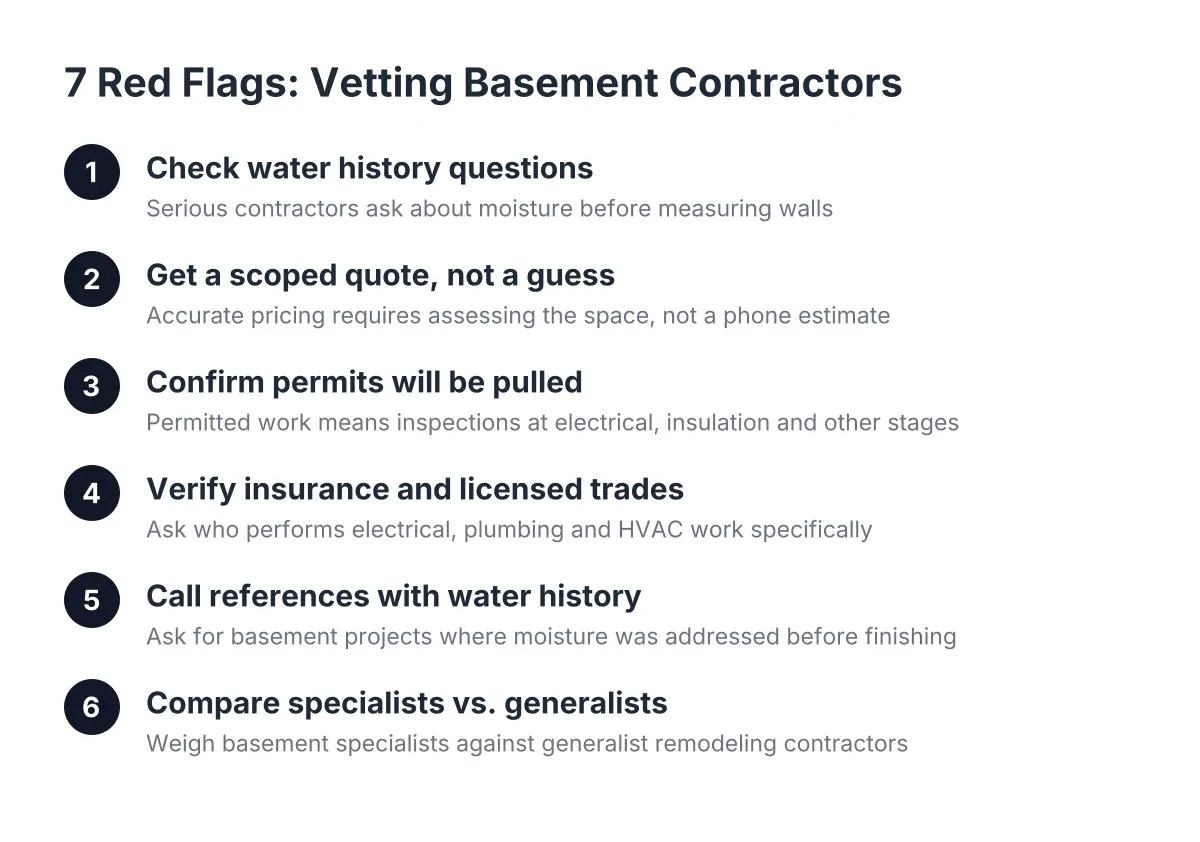
If your basement has ever taken on water after a heavy rain, you already know the stakes of hiring the wrong crew. Plenty of basement remodeling contractors will walk your lower level, tell you it looks dry, and start talking carpet colors. The good ones do something different: they ask about your water history before they measure a single wall. This list covers seven red flags to watch for when vetting basement remodeling contractors in St. Louis, written for the homeowner who has been burned once and refuses to finish over a problem twice.
You have already decided to finish the basement. The job now is making sure the person you sign with is the right one. Each item below is a specific warning sign, what it looks like in a real conversation, and what a straight answer sounds like instead.
1. They Never Ask About Your Water History
A contractor who does not ask when, where, and how often water has entered your basement is not planning to deal with it. Basements in St. Louis sit in clay-heavy soil that swells after storms, and any contractor working here should treat moisture as the first question, not an afterthought. If the walkthrough goes straight to layout and finishes, that is your cue to slow down.
Moisture and drainage problems have to be resolved before anyone insulates or frames against your foundation walls. Sealing insulation and drywall over an active leak traps water where it can feed mold and rot framing quietly for years. A serious contractor will want to see the basement after a hard rain, ask about efflorescence or staining on the walls, and check where your downspouts and grading direct water.
Suppose a homeowner in South County mentions that water pooled near the northeast corner twice last spring. The right response is a plan: identify the source, fix the drainage or grading, then finish. The wrong response is "we'll put down a moisture barrier and you'll be fine." A barrier under flooring manages vapor; it does not stop liquid water from a failing gutter or a hydrostatic leak.
2. They Quote a Price Before Understanding the Space
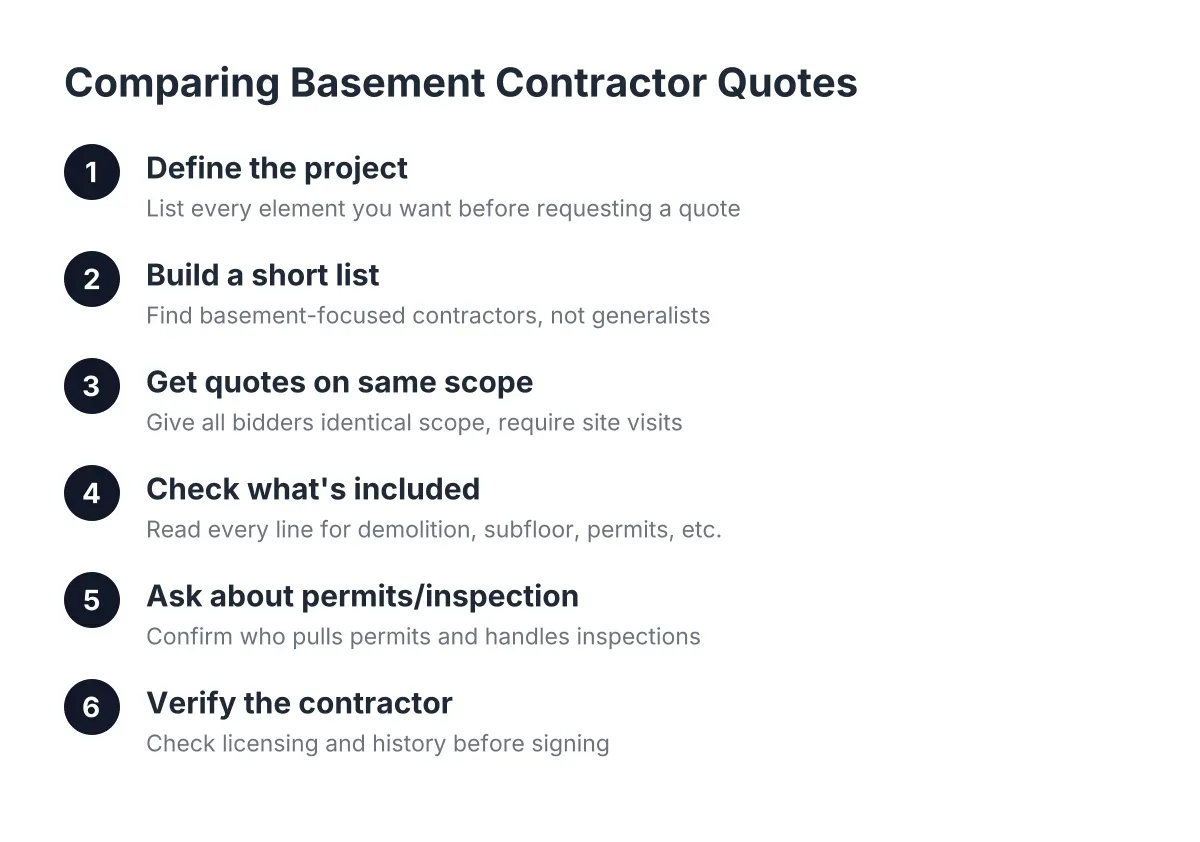
An accurate remodeling quote requires knowing what is behind and beneath the surfaces, not just the square footage. Anyone who hands you a firm number over the phone, before assessing moisture, ceiling height, load-bearing walls, and utility runs, is guessing. Guesses become change orders, and change orders become the surprise costs you were trying to avoid.
How much it costs to finish a basement depends on factors a walkthrough reveals: whether a load-bearing wall assessment changes your layout, whether the slab needs a plywood subfloor system, how far a new basement bathroom sits from the existing plumbing stack, and whether the space needs its own heating. A quote that does not itemize these is not a quote; it is an opening bid.
Ask for a written scope that separates line items so you can see where the money goes. In addition, ask how the contractor handles unknowns discovered after demolition. The honest answer acknowledges that opening walls sometimes changes the plan, and explains how pricing adjustments get documented and approved before work continues.
3. They Wave Off Permits
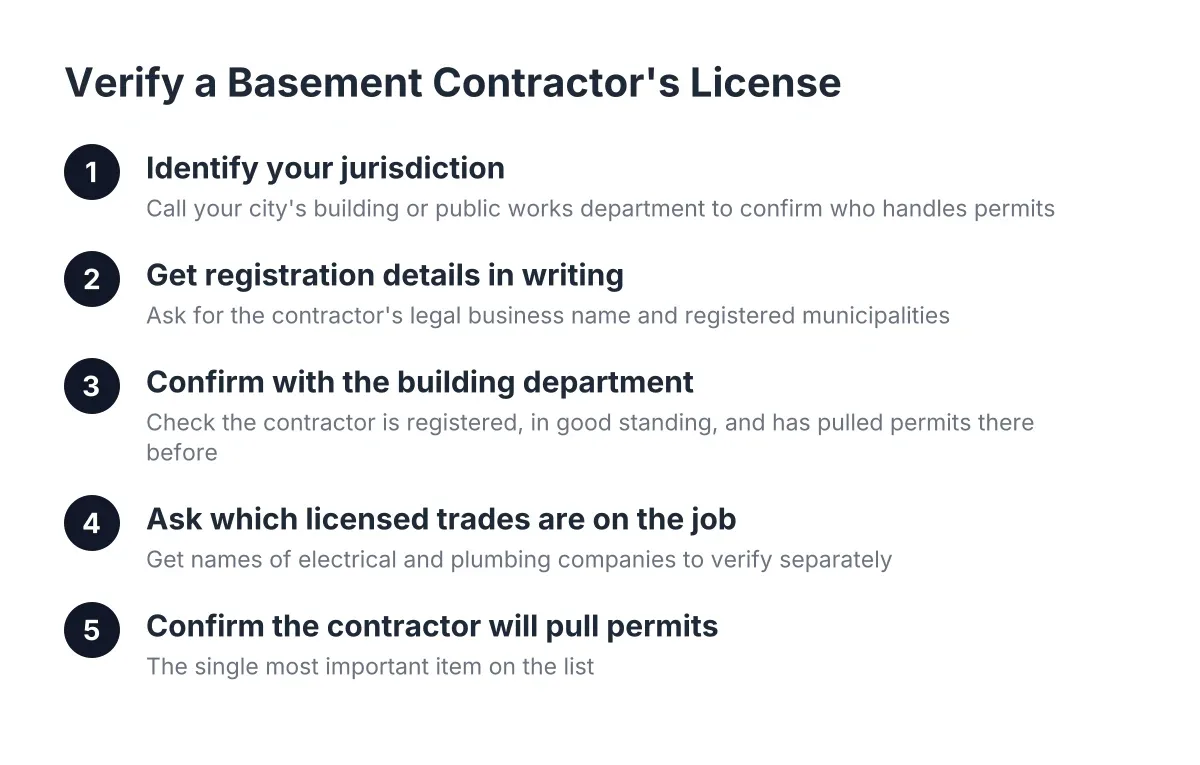
If a contractor tells you a permit is not necessary for a St. Louis basement finish, walk away. Finishing a basement involves framing, electrical, and often plumbing and HVAC, and that work gets inspected for a reason. Skipping permits saves the contractor hassle, not you; it leaves you holding unpermitted work when you refinance or sell.
Permitted basement finishing projects typically involve multiple inspections at different stages, such as an electrical rough-in inspection early on and an insulation inspection before drywall goes up. A contractor who works with inspectors regularly will describe this sequence without being prompted. One who gets vague about "do I need a permit" questions is telling you how they operate.
Permit requirements and fees vary by municipality within the St. Louis area, so a specific answer depends on where your home sits. What should not vary is the contractor's willingness to pull the permit in their own name and schedule the inspections themselves.
4. They Cannot Show Insurance or Explain Who Does the Licensed Work
Before signing anything, confirm two things in writing: current liability insurance, and exactly who performs the electrical, plumbing, and HVAC work. General carpentry, framing, and drywall are one skill set. Wiring a basement bar circuit or running gas to a new heater is another, and those trades require licensed professionals even on projects where the general contractor self-performs everything else.
A legitimate contractor will provide a certificate of insurance directly from their carrier, not a photocopy, and name the licensed subcontractors they use. If the answer to "who does your electrical" is "my guy," press for a company name you can verify. This matters more in basements than almost anywhere else in the house, because damp locations have stricter electrical code requirements. According to the National Electrical Code (NFPA 70), running standard non-metallic cable inside conduit in damp or wet locations violates code, which is exactly the kind of detail a licensed electrician catches and a handyman does not.
Therefore, treat vagueness about trades as a structural red flag, not a paperwork issue. The homeowner whose previous contractor laid carpet over a damp slab usually finds, later, that the same contractor cut corners behind the walls too.
5. Their References Do Not Include Basements With a Water History
References only help if they match your situation. A portfolio of kitchen remodels tells you nothing about how a contractor handles a slab that sweats in July or a foundation wall with old water stains. When you call references, ask for at least one basement project, and ideally one where moisture had to be addressed before finishing started.
Here are the questions worth asking a reference directly:
- Did the contractor identify any moisture issues before finishing, and how were they handled?
- Did the final cost match the written quote, and were changes documented?
- How did the project hold up through a full year of seasons, including spring storms?
- Were inspections passed on the first attempt?
- Would you hire them for a second basement project?
For example, say a reference tells you the contractor found insulation already installed against the concrete from a previous owner's half-finished attempt, tore it out, and started the wall assembly over correctly rather than building on top of it. That is the judgment you want. Building on a compromised existing assembly to save demolition cost is how mold problems get sealed inside new walls.
6. Specialists vs. Generalist Basement Remodeling Contractors
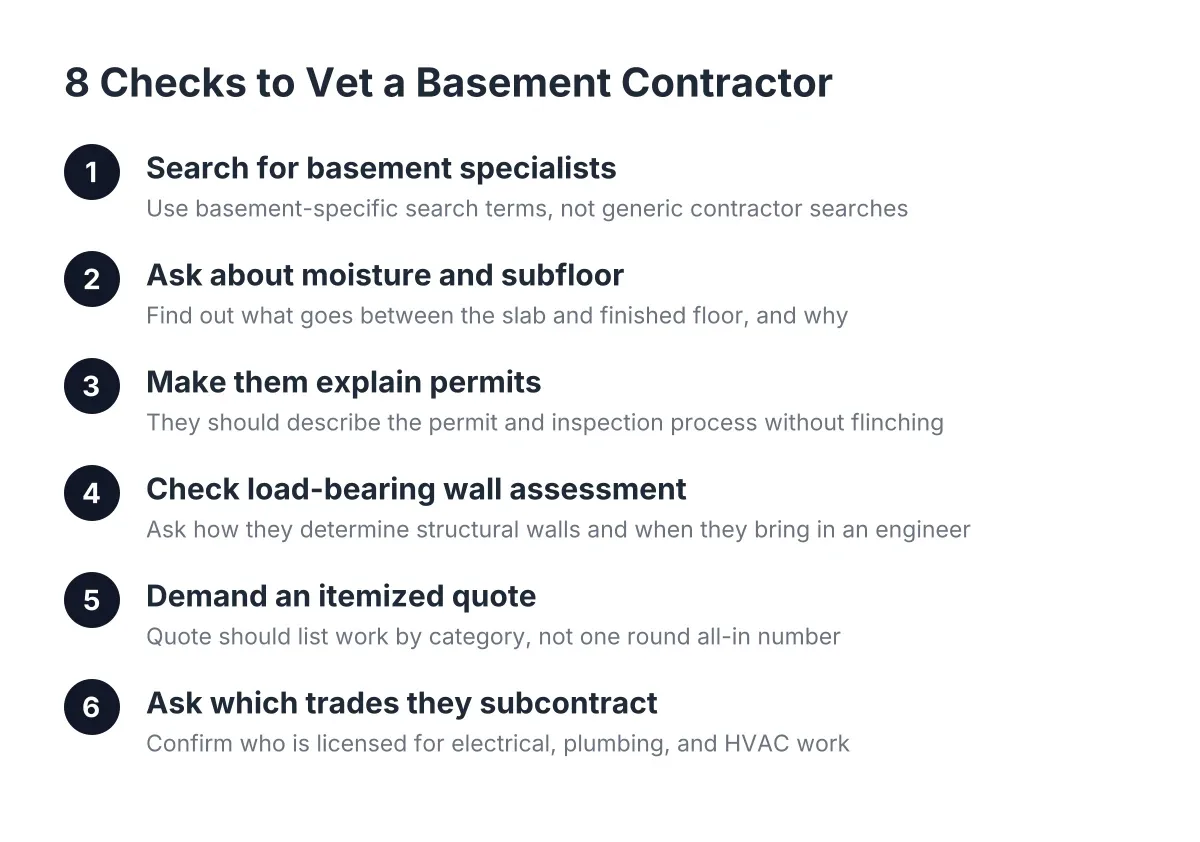
A generalist remodeler treats your basement as a smaller, cheaper version of an upstairs room. A basement specialist treats it as a different environment with its own rules: vapor drive through concrete, code requirements for below-grade electrical, egress considerations, and subfloor systems designed for slabs. The distinction shows up in the details of the proposal, not the sales pitch.
Test this during the estimate. Ask how they would handle flooring over your slab. A generalist often defaults to gluing carpet or laminate directly to concrete. A specialist explains the trade-offs of a plywood subfloor system, how a vapor barrier under or over the slab affects moisture movement, and why the answer changes based on your home's water history. According to W. R. Meadows, a vapor barrier placed over the base course under a concrete slab blocks moisture transmission from the ground into the concrete above; a contractor who understands what your slab does or does not have beneath it will plan the subfloor accordingly.
In addition, ask about trim. Finished basements involve far more baseboard, casing, and paneling work than homeowners expect, and generalist quotes routinely underestimate it. A line item that treats trim as an afterthought predicts a budget conversation you will not enjoy in month two.
7. They Tell You Everything You Want to Hear
The most dangerous contractor for a moisture-burned homeowner is the agreeable one. If you describe past flooding and the response is "it's dry now, you're good," you are being sold, not advised. Dry in October means nothing about April. The honest version of that conversation sometimes includes news you do not want: that waterproofing or drainage work needs to happen first, or that a section of the plan should wait.
Occasionally the honest answer is that finishing does not make sense yet at all. A basement with recurring standing water needs its water problem solved before any finishing budget is worth spending, and in some cases a structural or waterproofing professional should evaluate the foundation before a finishing contractor touches it. A contractor willing to say "not yet" or "not without this fix first" is showing you how they will behave when something unexpected turns up behind your drywall.
There is also a real trade-off to name. Addressing moisture first can add cost and time before the visible work starts, and a finished basement is rarely a strong return-on-investment play compared to other renovations. For a growing family that needs a playroom, a guest bedroom, or a basement bathroom, the value is the usable space itself. Go in with that framing and the budget conversations get easier.
How to Get an Accurate Quote From Basement Remodeling Contractors
An accurate basement remodeling quote comes from a contractor who inspects the space in person, documents moisture conditions, and itemizes the scope in writing before naming a price. Anything less is an estimate built on assumptions, and assumptions are where surprise costs live. Use the walkthrough itself as the final vetting step.
Searching "basement remodeling near me" produces a long list; the walkthrough is where the list gets short. Bring your water history, in writing if you have it: dates, locations, and photos of past leaks or staining. Then watch what the contractor does with that information. Hiring a contractor is less about finding the lowest bid and more about finding the person whose plan accounts for the specific risks in your specific basement.
Before signing, confirm the contract covers these items in writing:
- A moisture assessment and any required remediation, stated as its own scope item.
- Named licensed subcontractors for electrical, plumbing, and HVAC.
- Permits pulled by the contractor, with the inspection sequence spelled out.
- Itemized costs for framing, subfloor, flooring, bathroom rough-in, heating, and trim.
- A written process for pricing changes discovered after demolition.
As of 2026, none of this is exotic. It is simply the standard that separates basement remodeling contractors who plan for St. Louis conditions from crews who finish over problems and move on. You have been through the second kind once. The checklist above is how you make sure the next contract goes to the first kind.
If you need basement finishing, STL Basement Finishing can help.
Prefer to talk it through? Call (314) 916-6297 — a quick call is usually the fastest way to get a straight answer for your situation.