How to Find and Vet a Basement Remodel Contractor in St. Louis: 8 Honest Checks
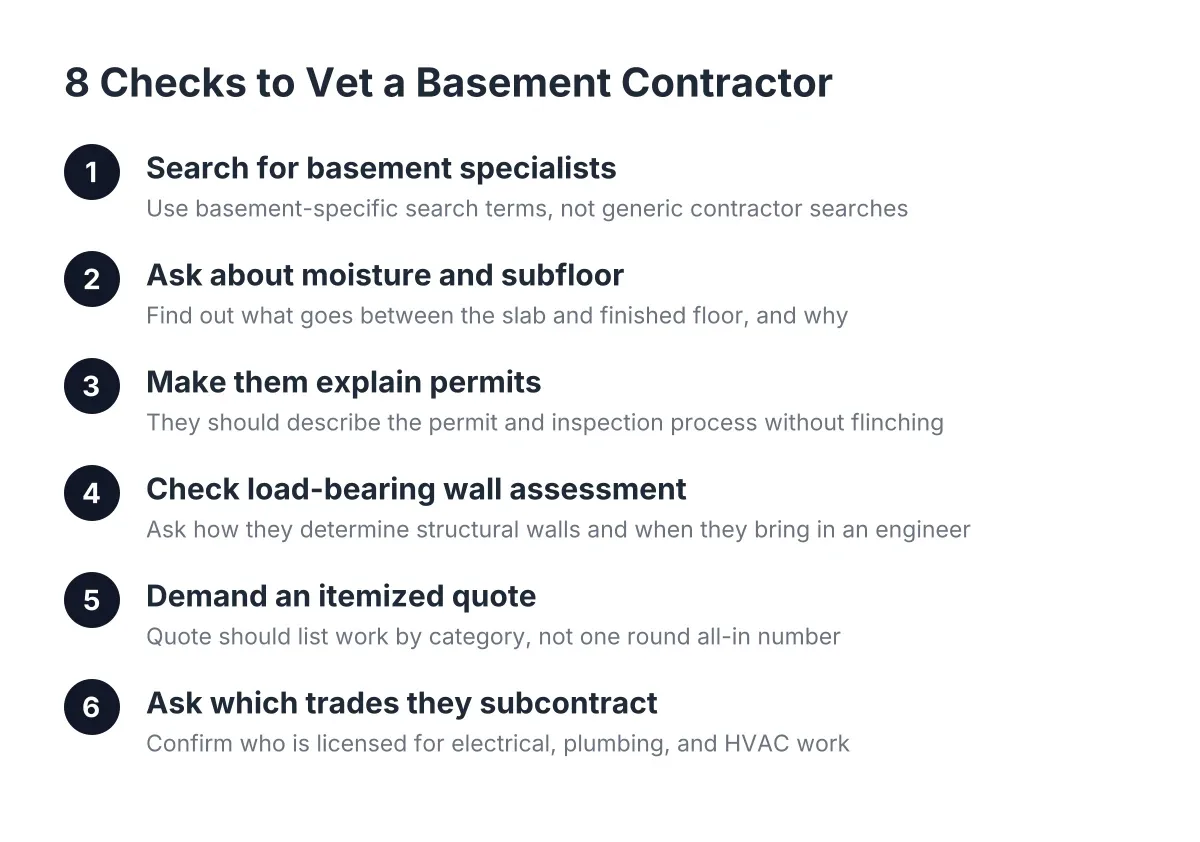
Searching for a basement remodel contractor in St. Louis turns up a mix of results: big kitchen-and-bath firms that treat basements as a side job, thin specialist sites with no real information, and a handful of contractors who actually do this work every week. The problem is that all three look about the same in a Google search for "basement remodeling near me." This list gives you eight specific checks that separate contractors who know basements from contractors who just say they do, so you can vet them the way a specialist would.
One note before the list. These checks matter more for a basement than for most projects. You are building living space below grade, on top of a concrete slab, around a load-bearing wall or two, with moisture, permits, and mechanicals all in play. A contractor who wings any of those does not leave a small mess. They leave a mess behind drywall.
1. Search for basement specialists, not just "best general contractor near me"
Start your search with basement-specific terms rather than generic ones. Typing "best general contractor near me" or "construction contractors near me" surfaces companies ranked for everything, which usually means they specialize in nothing. Instead, search phrases like "basement remodel near me," "basement remodel contractors," or "basement bar contractor St. Louis" and see who shows up with substance behind the listing.
Then look past the ranking to the site itself. A contractor who actually finishes basements will have real content on subfloor choices, permits, and what drives cost per square foot. A generalist will have a basement page with three sentences and a stock photo. In 2026, with most homeowners doing their vetting online before ever making a call, the depth of a contractor's website is a fair first read on the depth of their knowledge.
2. Ask how they handle moisture and the subfloor before anything else
The right first question for any basement contractor is what goes between your concrete slab and your finished floor, and why. Moisture moving up through the slab is the single most common reason finished basements fail, and the subfloor decision is where a specialist and a generalist part ways. According to W. R. Meadows, a vapor barrier placed over the base course under a concrete slab is meant to block moisture transmission from the ground into the concrete above; how your contractor works with or around that layer matters.
A specialist should walk you through the options without prompting: a plywood subfloor system versus flooring installed directly on the slab, and how that choice changes what carpet or hardwood is realistic in your space. If a contractor's answer is "we just put the flooring down," keep looking. That answer works in a living room and fails in a basement.
3. Make them explain permits in plain English
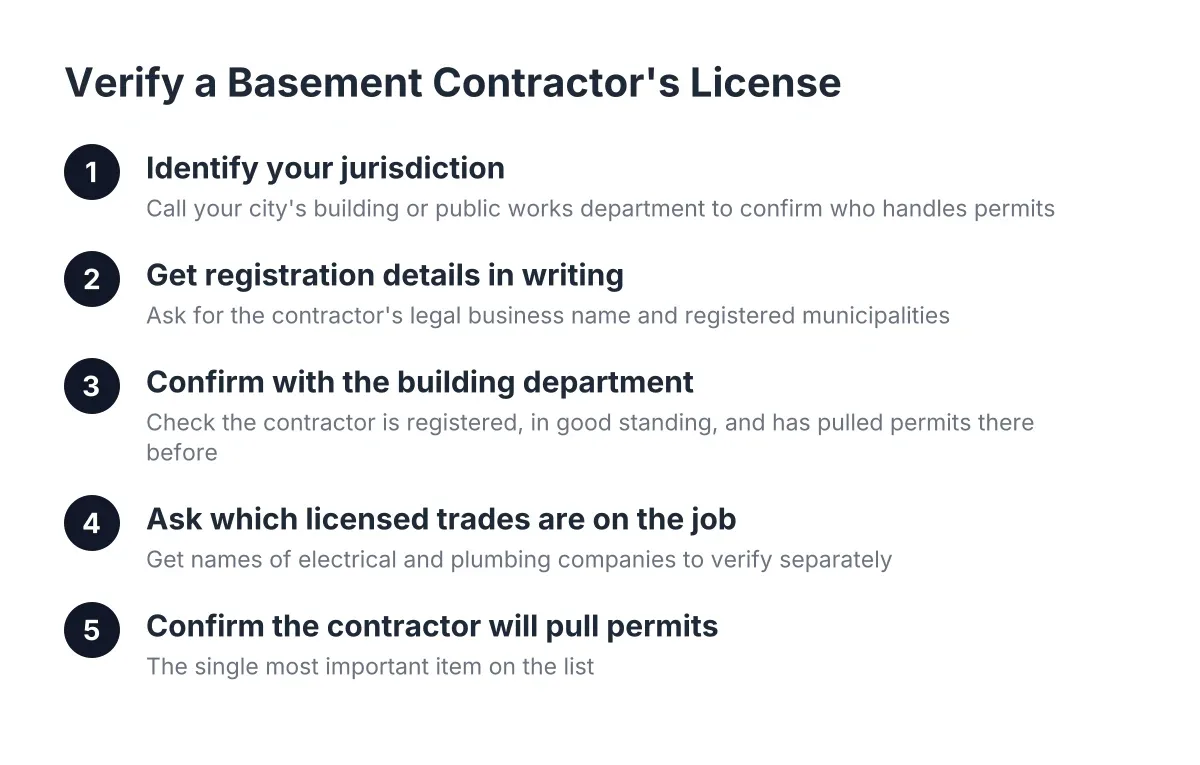
Ask the direct question: "Do I need a permit for this?" In St. Louis, a basement remodel that adds walls, electrical circuits, plumbing for a basement bathroom, or heating will involve permits and inspections, and a contractor who does this work locally should explain the process without flinching. Vague answers like "we can usually skip that" or "permits just slow things down" are the clearest red flag on this entire list.
There is a practical reason to press here. Basement finishing projects typically involve multiple inspections at different stages, such as an electrical rough-in inspection before insulation goes in, followed by an insulation inspection before drywall. A contractor who cannot describe that sequence has either not done many permitted basements or plans to skip inspections on yours. Either way, an unpermitted basement can surface as a problem when you sell the house.
4. Check that they actually assess load-bearing walls, not just build around them
A basement is full of structure that upstairs rooms hide: support columns, beams, and load-bearing walls that carry the floors above. Before any contractor talks layout, ask how they determine which walls and posts are structural and what their process is when your plan conflicts with one. A specialist has a real answer, including when they bring in an engineer.
This matters most if your vision involves opening up the space. Suppose you want a long basement bar with clear sightlines to a TV wall, and a support column sits right in the middle of it. A contractor who does load-bearing wall assessment and framing can tell you whether that column can be relocated with proper beam work, wrapped into the bar design, or left alone. A contractor who shrugs and says "we'll figure it out during demo" is telling you the figuring will happen on your dime.
5. Demand a quote that itemizes, and be suspicious of round numbers
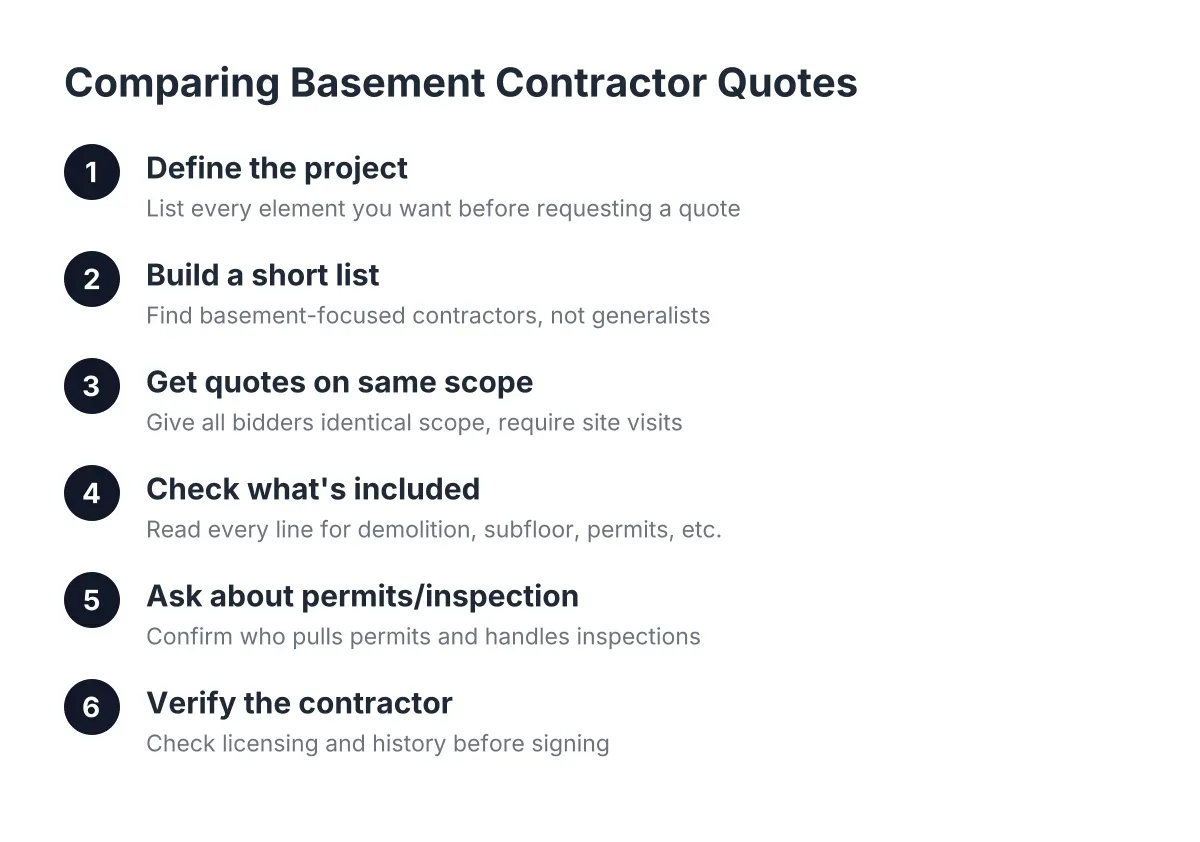
An accurate basement remodeling quote lists the work by category: framing, electrical, plumbing for a basement bathroom, HVAC or basement heating, subfloor, flooring, drywall, and finish work. It also states what is excluded and what triggers a change order. A single round figure on one page, say "$28,000, everything included," is not a quote. It is an opening bid that gets revised once your walls are open.
To compare bids fairly, give every contractor the same scope in writing and ask each one the same questions:
- What is included in this number, and what is specifically excluded?
- How do you handle surprises behind existing walls or under the slab?
- What allowances are built in for flooring, fixtures, and bar finishes, and what happens if I pick something above the allowance?
- Who pulls the permits, and is that cost in the quote?
- How is payment scheduled, and what work milestone triggers each payment?
The cheapest bid on a basement remodel is often the least complete one. When one number comes in far below the others, the difference is usually in what was left out, not in efficiency.
6. Ask which trades they subcontract and who is licensed for what
Even skilled contractors do not do everything in-house, and they should not. Electrical and HVAC work in a basement requires licensed trades, and the standard practice among reputable contractors is to bring in a licensed electrician and HVAC contractor for those portions even when their own crew handles framing, drywall, and finish work. Ask directly: who does the electrical, who does the mechanical, and who runs the plumbing for the basement bathroom?
You are listening for a clear division of labor, not a specific roster. A contractor who claims one crew does everything from panel work to gas lines is either understating what basement work involves or overstating what his crew is licensed to touch. Hiring a contractor for a basement is really hiring a coordinator of several trades, and the coordination is where projects succeed or stall.
7. Test whether they can build your vision, not just a generic finish
If you want a basement bar, a guest suite with its own bathroom, or anything beyond four drywalled walls and carpet, ask to see comparable work. Not their portfolio in general; the specific thing. Photos of a finished basement bar with plumbing, cabinetry, and lighting tell you far more than a stack of generic before-and-after basement shots.
Then test their thinking with your actual space. Say a homeowner in South County wants a wet bar along the back wall, but the drain line sits on the opposite side of the basement. A contractor with real basement bar experience will immediately talk through options like an ejector pump, rerouting, or flipping the layout, and what each does to cost. A generalist will nod, write nothing down, and price it wrong. The same test applies to smaller design problems: a good basement contractor has an answer for dead space under the stairs, whether that means opening it up structurally or cutting a smaller accent-lit opening when the framing cannot move.
8. Watch how they talk about basement remodel cost drivers
You will not get an honest fixed cost per square foot over the phone, and you should not trust anyone who offers one. What you should get is a clear explanation of what moves the number in your specific basement: whether you are adding a bathroom, how much electrical the layout needs, ceiling height and ductwork obstacles, the subfloor system, moisture conditions, and the finish level you choose. A contractor who explains those drivers before quoting is showing you how they think.
Timing honesty counts here too. When material prices are climbing sharply, a straight-shooting contractor may tell you that waiting a season could serve your budget better than starting mid-spike. That advice costs them a job in the short term, which is exactly why it is a strong trust signal when you hear it. Likewise, be wary of anyone selling a basement finish purely as an investment; basements rarely return their full cost at resale unless the renovation is done to a high standard throughout, so the honest pitch is livable space first, resale value second.
What separates basement remodel specialists from generalists
The pattern across all eight checks is the same. Generalists answer basement questions in general-remodeling terms: square footage, finish selections, a start date. Specialists answer in basement terms: slab moisture, vapor barriers, plywood subfloor versus direct-glue flooring, load-bearing wall assessment, ejector pumps, rough-in inspections, and basement heating that actually keeps the space comfortable in a St. Louis January.
You do not need to become an expert to vet a contractor. You need to ask the eight questions above and listen for specifics. The contractor who explains the why behind each answer, puts the scope in writing, and pulls permits without being asked is the one who will still be answering your calls in week six of the project. For anything structural, or if you suspect active water intrusion, bring in a professional to assess the basement before you sign with anyone; no finish plan survives a wet slab or a compromised beam.
If you need basement finishing, STL Basement Finishing can help.
Prefer to talk it through? Call (314) 916-6297 — a quick call is usually the fastest way to get a straight answer for your situation.