Epoxy Floor Paint vs. Vinyl for Basements: Durability, Cost, and Moisture
If you have ever pulled up damp carpet in a basement after a heavy St. Louis rain, you already know why the flooring decision matters more down there than anywhere else in the house. The epoxy floor paint vinyl comparison comes up constantly with new homeowners, and for good reason: both options handle moisture better than carpet or hardwood laid straight on concrete. But they solve different problems, and choosing the wrong one for your situation is how basements end up smelling musty two summers after they were finished. When comparing epoxy vs vinyl basement flooring over concrete, moisture management becomes the defining factor.
This article compares epoxy floor paint and vinyl plank flooring specifically for basements over concrete slabs. Not garage floors, not above-grade kitchens. Basements, where moisture pushes up through the slab whether you can see it or not, and where a finished floor either accounts for that or fails because of it.
Why Basement Floors Are a Different Problem
A basement floor sits on a concrete slab poured directly over the ground. Concrete is porous, and water vapor from the soil migrates up through it year-round. In a St. Louis basement, that vapor drive gets worse after storms and in humid summers, even when the slab looks bone dry.
Some slabs have a vapor barrier underneath. A vapor barrier placed over the base course under a concrete slab is meant to block moisture transmission from the ground into the concrete above, according to W. R. Meadows. However, plenty of older St. Louis homes were built without one, and you cannot see it either way.
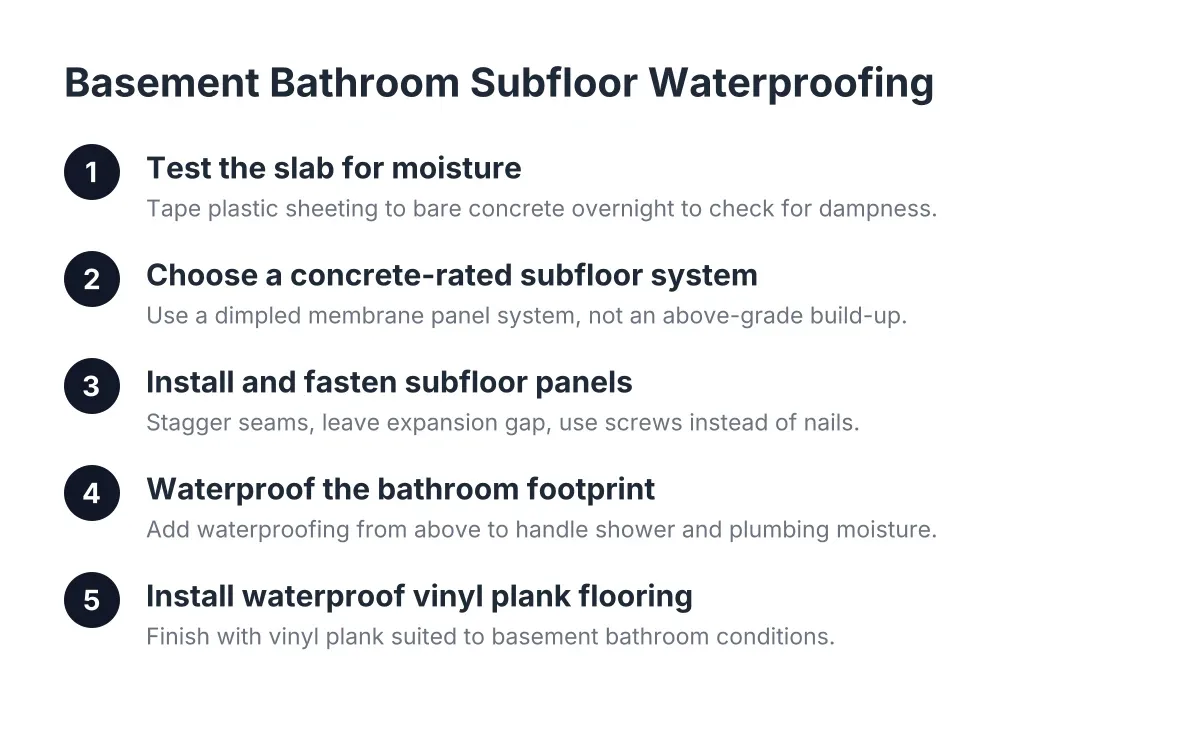
There is a simple check you can run this weekend. Tape a garbage bag or plastic sheet flat to the concrete floor, seal all four edges, and leave it overnight. If you find condensation on the underside the next morning, moisture is moving through that slab, and there is likely no vapor barrier below it. That result should shape every flooring decision you make from here.
This is the piece a lot of homeowners learn the hard way. If a previous contractor put carpet straight on your slab and never mentioned moisture, the problem was not the carpet. It was skipping the question of what the slab does when it rains.
Epoxy Flooring for Basements: How It Works
Epoxy floor paint is a two-part coating, a resin and a hardener, that you mix and roll onto prepared concrete. Once it cures, it chemically bonds to the slab and forms a hard, continuous plastic layer. It is not paint in the ordinary sense; latex "concrete paint" is a different, weaker product that peels under moisture.
A properly cured epoxy coating does real work in a basement. It acts as a continuous vapor barrier, an air control layer, and a capillary break, stopping moisture and soil gas from moving through the slab surface into the room. It also locks down concrete dust, which matters more than people expect. An epoxied utility room floor keeps slab dust from drifting into the finished side of the basement every time someone opens the door.
Is Epoxy Floor Paint Waterproof?
Cured epoxy floor paint is waterproof on its surface; water sitting on top will not soak through the coating. The catch is what happens underneath. If heavy vapor drive pushes moisture up through a slab with no vapor barrier below it, that pressure can blister or delaminate the coating from beneath over time.
So the honest answer is conditional. Epoxy resists water from above without issue. From below, it depends on your slab. This is also why surface prep matters so much; epoxy fails at the bond line, not in the middle of the coating. Concrete itself can trap problems too. Blisters in cured concrete come from trapped air, often from finishing the surface too soon or from a vapor barrier stopping water from absorbing into the subgrade, according to the NRMCA. A slab with existing surface defects needs grinding and repair before any coating goes down.
Vinyl Flooring for Basements: Installation and Performance
Vinyl in a basement usually means luxury vinyl plank, LVP, floating over the slab or over a subfloor. It is one of the few finished-floor materials genuinely suited to below-grade rooms. Vinyl plank resists humidity and direct moisture, and it does not cup, bow, or buckle the way solid or engineered wood can when basement humidity swings between January and July.
Vinyl also feels like a floor in a living space. Epoxy reads as a garage or workshop surface. Vinyl plank reads as a family room, a basement bar area, or a finished bathroom. For a buyer who just closed on a house and wants the basement done before the furniture arrives, that difference is usually decisive for the living areas.
However, vinyl does not seal the slab. Water vapor still comes up through the concrete underneath it. Most quality vinyl plank tolerates that vapor without damage, but the moisture has to go somewhere. Trapped under a tight floating floor with no path to dry, it can feed the musty smell every moisture-burned homeowner recognizes.
That is where a subfloor changes the picture. A dimpled-membrane subfloor panel raises the finished floor slightly off the concrete and creates an airspace underneath. Vapor coming through the slab can migrate through that airspace toward drier zones and escape instead of accumulating. Even a basement that does have a vapor barrier under the slab benefits from a subfloor system, because it protects the finished floor from future moisture events, not just everyday vapor. Basement subfloor installation is a separate line item from the flooring itself, but for a slab that failed the plastic-bag test, it is the difference between a floor that lasts and one you replace.
Epoxy Floor Paint vs. Vinyl: The Direct Comparison
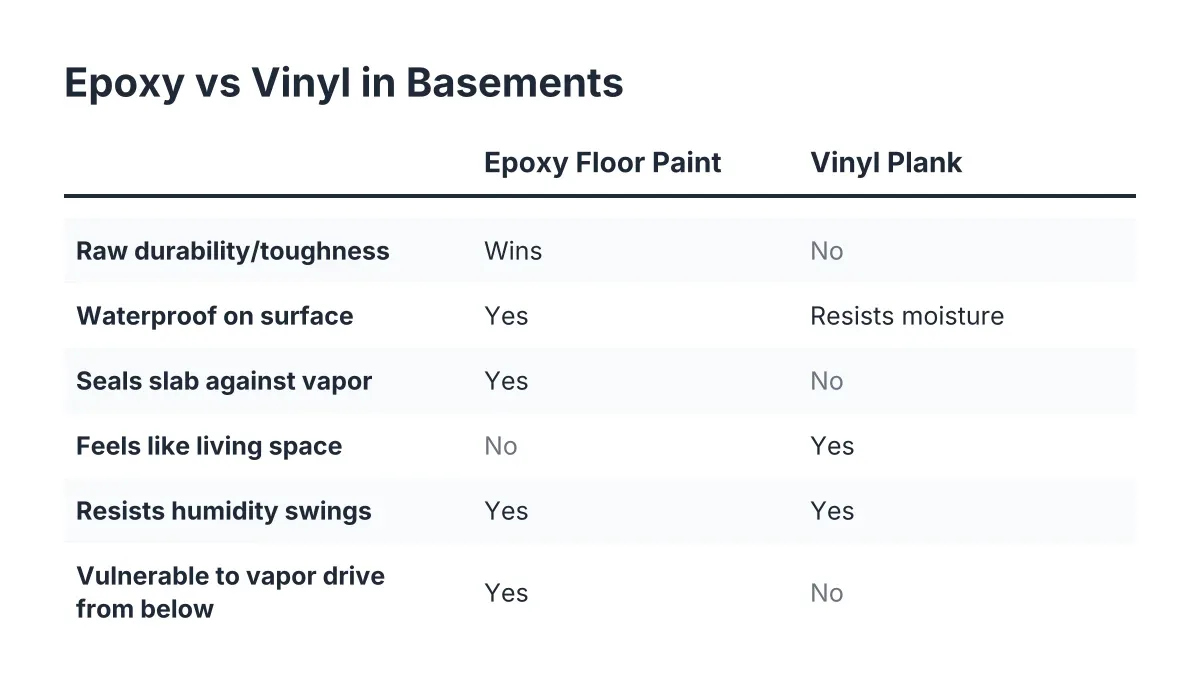
Here is how the two options stack up on the criteria that matter in a basement, as of 2026.
Durability
Epoxy wins on raw toughness. A cured epoxy floor shrugs off dropped tools, dragged storage bins, shop traffic, and standing water. Its weak point is the bond to the concrete; poor prep or heavy vapor drive from below can lift it.
Vinyl plank is durable for living-space use, with wear layers built for furniture, kids, and pets. It scratches and dents more easily than epoxy under hard use, and individual planks can be replaced if damaged. Epoxy repairs mean recoating a section, which rarely blends invisibly.
Cost
Neither option has one fixed price, and we will not invent numbers here. What actually drives the cost:
- Slab condition. Cracked, dusty, or previously painted concrete needs grinding and patching before epoxy, which adds labor.
- Moisture status. A slab that fails the moisture test may need a subfloor system under vinyl, or moisture-tolerant primers under epoxy.
- Product tier. Bargain epoxy kits and thin builder-grade vinyl both exist, and both underperform in basements. Wear layer thickness and coating build matter.
- Square footage and layout. Cost per square foot drops on open rectangles and rises with stairs, closets, and mechanical rooms.
- What sits on top. Vinyl in a finished basement usually rides along with framing, drywall, and trim work; epoxy is often a standalone scope.
As a rough illustration, suppose a homeowner in South St. Louis County closes on a 1960s ranch with an 800 square foot unfinished basement. Say they epoxy the 200 square foot utility and laundry area to control dust, and put a subfloor with vinyl plank across the 600 square feet becoming the family room and basement bar. That split-scope approach is common because it matches each product to what each zone actually does.
Waterproofing and Moisture Behavior
Epoxy seals the slab surface and blocks vapor at the concrete face. That is a genuine advantage when the coating holds, and a liability when vapor pressure is strong enough to attack the bond.
Vinyl over a dimpled subfloor takes the opposite approach: let the vapor through the slab, give it an airspace to travel and dry, and keep the finished floor decoupled above it. For a basement with a known moisture history, the vinyl-plus-subfloor approach is usually the more forgiving one, because it does not depend on winning a pressure fight with the ground.
Neither one fixes bulk water. If water flows in during storms, that is a drainage and grading problem to solve before any flooring conversation. A contractor who quotes you epoxy floor paint, vinyl plank, or anything else without asking how the basement behaves after a two-inch rain is skipping the step that matters most.
Comfort and Livability
Epoxy is hard and cold underfoot, and it echoes. Vinyl plank is warmer and quieter, and over a subfloor with an airspace it gains a thermal break that takes the concrete chill out of the floor. In finished rooms, carpet remains the budget-friendly, echo-absorbing option, but for anyone burned by wet carpet before, vinyl plank is the moisture-safe middle ground.
Can You Combine or Layer Them?
You can use epoxy and vinyl in the same basement, and many finished basements should. What you should not do is layer one over the other casually. Applying epoxy floor paint over vinyl flooring or old vinyl tile is a prep-intensive job; coatings bond poorly to flexible, plasticized surfaces, and older vinyl tile can contain asbestos that must not be sanded. Painting over a cured epoxy floor is possible with the right prep and compatible products, but going the other direction, vinyl over epoxy, generally works fine since floating planks do not need to bond to the coating.
The practical combination is by zone: epoxy in the utility room, workshop, and storage areas; subfloor and vinyl plank in the living areas, basement bar, and basement bathroom.
Where Each One Belongs in a St. Louis Basement
For the homeowner who just bought a house with an unfinished basement and financing set aside to finish it, the decision usually sorts itself by room:
- Utility and mechanical rooms: epoxy. It controls dust, cleans up easily, and handles a water heater drip or condensate leak without damage.
- Family rooms, basement bars, and bedrooms: subfloor plus vinyl plank. It looks and feels like living space and tolerates basement humidity.
- Basement bathrooms: vinyl plank or tile over a properly prepped base, with the plumbing rough-in and permit questions settled first.
- Basements with a wet history: solve drainage first, then subfloor, then flooring. In that order, no exceptions.
Permits deserve a mention here. Flooring alone rarely triggers one, but a full basement finishing project in St. Louis, framing, electrical, and a bathroom addition, does. If you are asking "do I need a permit," the answer for a real finishing project is almost always yes, and a contractor who waves that off is telling you something about how they handle the moisture questions too.
How to Choose
Start with the slab, not the product. Run the overnight plastic test. Walk the basement after the next hard rain and look for damp lines at the wall base. Then match the floor to what you find and to how each room will be used.
Choose epoxy where the room works hard and looks do not matter: utility, laundry, storage, workshop. Choose vinyl plank, over a subfloor whenever moisture tested positive or the basement has any water history, wherever people will actually live. If bulk water shows up after storms, stop and fix the water problem first; no floor coating or plank is the cure for that, and any diagnosis of active leaks or suspected mold is a job for a professional, not a weekend project.
The homeowners who regret their basement floors are almost never the ones who picked the "wrong" product. They are the ones whose contractor never asked what the slab does when it rains. Ask that question first, of yourself and of anyone you hire, and the choice between epoxy and vinyl basement flooring can serve you well when made with moisture conditions in mind.
Prefer to talk it through? Call (314) 916-6297 — a quick call is usually the fastest way to get a straight answer for your situation.