Epoxy Basement Floor Cost vs. Carpet: What St. Louis Slabs Actually Demand
If you have been pricing basement flooring, you have probably noticed something frustrating: epoxy basement floor cost estimates online range from a weekend DIY kit to numbers that rival a full remodel, and nobody explains why. Carpet quotes swing just as wide. The reason has less to do with the flooring itself and more to do with what is underneath it. In St. Louis, that means a concrete slab that is often decades old, poured over clay soil, and sitting in a region with a high water table and humid summers. This guide compares epoxy and carpet head to head on the three things that actually matter for a basement: moisture performance, durability, and what you will really pay, so you can check the numbers against your budget before you let anyone into your house.
Why Your Slab Decides the Flooring, Not the Showroom
Here is the point most flooring articles skip. In a basement, you are not choosing flooring for a room. You are choosing flooring for a concrete slab that sits below grade, and that slab has opinions.
Concrete is porous. Moisture in the soil under your basement moves up through the slab as water vapor, even when the floor looks bone dry. In older St. Louis homes, especially those built before vapor barriers under slabs became standard practice, that vapor drive is constant. Add a wet spring, a high water table, or a past water intrusion event, and the slab becomes the single biggest variable in your project.
This is why two neighbors can install the same flooring and get different results. One has a dry, level slab in a house on high ground. The other has a 1962 slab in a low-lying part of the metro with a musty smell every July. Same product, different outcomes, and the difference shows up either in the upfront prep cost or in a failure two years later.
Therefore, before comparing epoxy against carpet, accept one rule: the flooring you choose must match your slab's moisture condition, not the other way around. Everything below builds from that rule.
How Epoxy and Carpet Handle Basement Moisture
Epoxy and carpet sit at opposite ends of the moisture spectrum, and neither one is automatically right.
Epoxy: a coating, not a floor covering
Epoxy is a two-part resin that chemically bonds to the concrete and cures into a hard, plastic-like surface. Because it bonds directly to the slab, there is no gap underneath for water to pool, no padding to soak, and no organic material to feed mold. If your basement takes on water, you mop an epoxy floor and move on. For homeowners in flood-prone parts of the region, that single trait is often the whole argument.
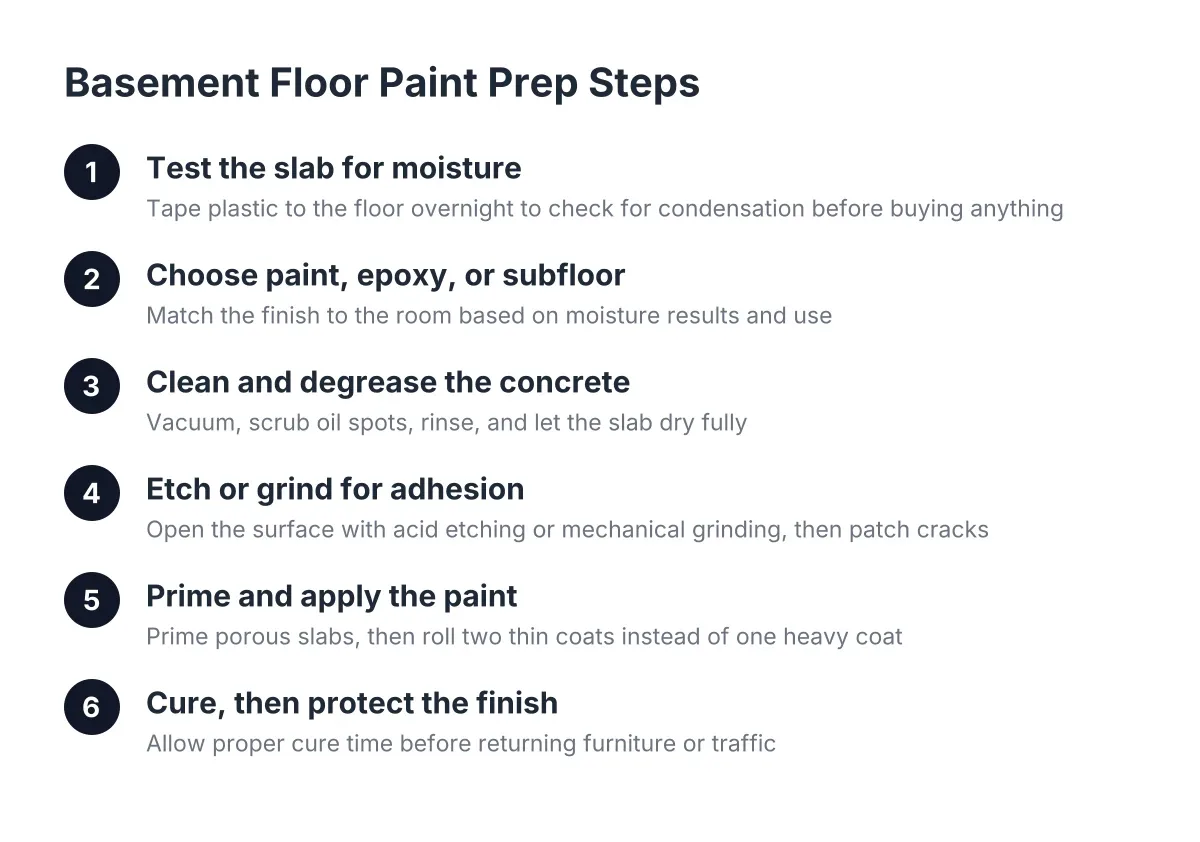
However, that direct bond is also epoxy's weakness. Epoxy does not breathe. If your slab has significant moisture vapor pushing up from below and it gets sealed under a coating, the pressure can cause the epoxy to bubble, whiten, or peel in sheets. A moisture test on the slab before coating is not optional; it is the difference between a floor that lasts and a floor that fails in the first humid season.
Carpet: comfort with a condition attached
Carpet is the opposite bet. It is the warmest, softest, and cheapest-feeling option underfoot, which matters in a basement family room or a finished space where kids play on the floor. Basements run cool in St. Louis winters, and carpet with a good pad takes the chill off better than any hard surface.
The condition is moisture. Carpet and pad laid directly on a below-grade slab absorb vapor from the concrete, and that trapped dampness is where musty basement smell comes from. If the basement has ever taken on water, carpet on bare concrete is the first casualty and often has to be cut out and thrown away. The fix is not skipping carpet; it is putting a proper subfloor between the carpet and the slab. A plywood subfloor over a vapor barrier, or a raised subfloor panel system, creates an air gap and a moisture break that lets carpet perform the way it does upstairs.
So the honest comparison is not epoxy versus carpet. It is epoxy on a tested slab versus carpet on a proper subfloor. Price either one without its moisture strategy and you are pricing a future problem.
What Determines Epoxy Basement Floor Cost in St. Louis Homes
The cost of an epoxy basement floor is driven mostly by slab condition and prep work, not the epoxy itself. Coating material is a modest share of the total. Grinding, crack repair, moisture mitigation, and the number of coats determine whether your project lands at the low end of the range or several times higher.
Here is where the money actually goes:
- Surface prep. Old slabs need diamond grinding to open the concrete pores so epoxy can bond. A slab with old paint, glued-down tile mastic, or oil stains takes more grinding, and prep is labor, which is where cost lives.
- Crack and spall repair. St. Louis clay soil moves, and slabs crack. Every crack gets cleaned and filled before coating, and a heavily cracked slab adds real hours.
- Moisture mitigation. If a moisture test shows high vapor drive, the slab needs a moisture-blocking primer before the epoxy. This is the line item that surprises people, and it is also the one you should never let a low bid skip.
- Coating system. A single-coat garage-style application costs far less than a full-broadcast flake system with a urethane topcoat, and it wears far less time too. Residential epoxy basement floor cost scales with the number of layers and the quality of the topcoat.
- Square footage and layout. Bigger floors cost more in total but often less per square foot. Lots of cut-ins around posts, a furnace, and a water heater slow the crew down.
This is also why the DIY kits deserve a warning. An epoxy basement floor cost DIY comparison looks tempting on the shelf, but big-box kits are typically thin, water-based coatings applied over minimal prep. On a below-grade slab with any vapor drive, they are the version most likely to peel. If you are set on doing it yourself, spend your money on the grinder rental and a moisture test before you spend it on the kit.
One more note on shopping around. When you compare epoxy basement floor cost per square foot between bids, make sure each bid states what prep is included. A number that looks like a bargain often assumes a clean, dry, crack-free slab that your 40-year-old basement does not have. The change order arrives later.
Carpet Costs in a Basement: The Subfloor Is the Real Line Item
Carpet pricing looks simple because the carpet and pad are simple. The complication is everything a basement adds underneath.
Upstairs, carpet goes over a wood subfloor that already exists. In a basement, that layer has to be built. A vapor barrier plus plywood subfloor, or an interlocking subfloor panel system, adds material and labor that upstairs carpet never needed. It also raises the floor height, which matters at the bottom of the stairs and at any door, and it is one reason a contractor will want to check ceiling height and stair clearance before quoting.
In addition, basements complicate the perimeter. Tack strips need something to anchor to, floor drains need to stay accessible, and any area near a future basement bathroom needs to be planned before the subfloor goes down, not after. If a bathroom addition is part of your finished basement plan, the plumbing rough-in has to happen before flooring of any kind. Sequencing it wrong means cutting up a brand-new floor.
The payoff for that extra structure is real. Carpet over a proper subfloor in a basement family room feels like a normal room in the house, not a converted cellar. For a basement bar area or a media room where people sit on the floor and kids sprawl out, that comfort is the reason carpet keeps winning despite the moisture caveats.
The trade-off is lifecycle. Carpet in a basement, even over a good subfloor, has a shorter life than epoxy. It stains, it mats in traffic lanes, and if water ever gets past your defenses, it is done. Epoxy, properly installed, can outlast two or three rounds of carpet. Cheap today and durable today are different purchases.
A Side-by-Side Scenario: One Basement, Two Bids
Numbers in the abstract do not help you check your budget, so here is an illustrative scenario. Suppose a homeowner in south St. Louis County has an 800 square foot basement in a 1970s ranch. The slab has two hairline cracks, a faint musty smell in summer, and no history of standing water. She wants a finished space for a family room and, eventually, a basement bar.
In that scenario, the epoxy path looks like this: moisture testing, full grinding, crack repair, a moisture-tolerant primer because of the summer mustiness, then a flake broadcast system with a urethane topcoat. The prep and primer are the bulk of the bill. What she gets is a floor that shrugs off water, never harbors mold, and handles a bar area where drinks will spill. What she gives up is warmth and softness; she will want area rugs, and area rugs on epoxy are the common compromise.
The carpet path for the same basement looks like this: vapor barrier, plywood subfloor or raised panels across the full 800 square feet, then pad and carpet. The subfloor roughly doubles what she expected to pay for "just carpet," which is the moment most budget-focused homeowners feel misled by online carpet prices. What she gets is a genuinely warm, quiet room. What she accepts is that a future water event costs her the carpet, though the subfloor protects the framing and drywall above it.
Either path can be the right call. The wrong call is the third path she will also be offered: carpet and pad glued straight to the slab at the lowest bid in the stack. That bid is cheapest because it skipped the moisture strategy, and in a St. Louis basement with a summer musty smell, that is not a corner cut, it is the whole foundation of the job removed.
Comparing Epoxy and Carpet: Which Is Actually Cheaper?
For most St. Louis basements, carpet installed without a subfloor is the cheapest option upfront, epoxy sits in the middle, and carpet over a proper plywood subfloor often costs the most on day one. Over a ten-year horizon, epoxy usually wins on total cost because it does not need replacement after moisture events or normal wear.
That ranking flips depending on your slab. A dry, sound slab keeps epoxy prep minimal and makes epoxy competitive with even basic carpet. A slab with high vapor drive adds moisture mitigation to the epoxy bid and makes the subfloor mandatory for carpet, raising both numbers. This is why quoting a single cost per square foot for basement flooring without seeing the slab is guesswork, and why the honest answer to "how much does it cost to finish a basement floor" always starts with the slab's condition.
There is also a middle path worth knowing about as you weigh basement flooring options: many finished basements use both. Epoxy or luxury vinyl plank in the bar, laundry, and utility zones where water risk is highest, and carpet over subfloor in the family room where comfort matters most. Zoning the floor this way puts the durable surface where spills happen and the warm surface where people live, and it often costs less than doing the whole footprint in the more expensive system.
Questions to Ask Before You Accept Any Flooring Bid
You do not need to be an expert to protect yourself. You need the right five questions, asked of every contractor, so the bids become comparable.
- Did you test the slab for moisture, and what was the result? Any epoxy bid without a moisture test is a guess. Any carpet bid that ignores moisture is a liability.
- What surface prep is included in this number? For epoxy, that means grinding and crack repair spelled out. For carpet, it means the subfloor system named, with vapor barrier included.
- What happens to this price if you find problems after grinding or demo? Get the answer in writing. This is how you prevent the mid-project change order you have been warned about.
- How does this floor interact with the rest of the finish plan? Flooring height affects stair code, door clearances, and any planned basement bathroom rough-in. A flooring-only bid that ignores the rest of the basement finishing plan creates rework.
- Do I need a permit for this work? Flooring alone often does not trigger one, but the moment the project includes framing, electrical, or a bathroom addition, permitting rules in St. Louis and the surrounding municipalities apply. A contractor who waves the question off is telling you something.
One honest limitation: if your basement has active water intrusion, a failing foundation wall, or standing water after storms, no flooring decision comes first. Those conditions need to be diagnosed and corrected before any finish work, and some structural problems fall outside a finishing contractor's scope and belong with a structural engineer.
The Bottom Line for Budget-First Homeowners
Strip away the marketing and the comparison comes down to this. Epoxy is the durability and moisture play; its cost lives in slab prep, and its risk is a skipped moisture test. Carpet is the comfort play; its real cost lives in the subfloor, and its risk is a bid that leaves the subfloor out to look cheap.
The wide range of epoxy basement floor cost figures you see online, from Reddit threads to national cost guides in 2026, is not contractors making numbers up. It is the honest spread between a clean slab needing one coat and an old St. Louis slab needing grinding, crack repair, moisture mitigation, and a full flake system. Your basement sits somewhere specific on that spread, and a moisture test plus a written scope is how you find out where.
Set your budget around the slab first, the flooring second. Get every bid itemized so prep and subfloor work are visible line items, not surprises. Do that, and whichever direction you choose, epoxy, carpet, or a zoned mix of both, you will be the homeowner comparing real numbers instead of guessing between a $15,000 story and an $80,000 one.
If you need basement finishing, STL Basement Finishing can help.
Related guide: basement flooring options — Complete Guide
Prefer to talk it through? Call (314) 916-6297 — a quick call is usually the fastest way to get a straight answer for your situation.