Basement Flooring for High Moisture: 8 Materials That Survive a Wet St. Louis Slab
If water has come into your basement before, you already know the stakes. Choosing basement flooring for high moisture conditions is not about picking the prettiest sample at the store; it is about selecting wet basement flooring materials that will not feed mold, warp, or peel the first time a St. Louis storm pushes water vapor up through the slab. This list walks through eight flooring choices that hold up when the slab is not perfectly dry, plus what has to happen underneath each one so you are not finishing over a problem.
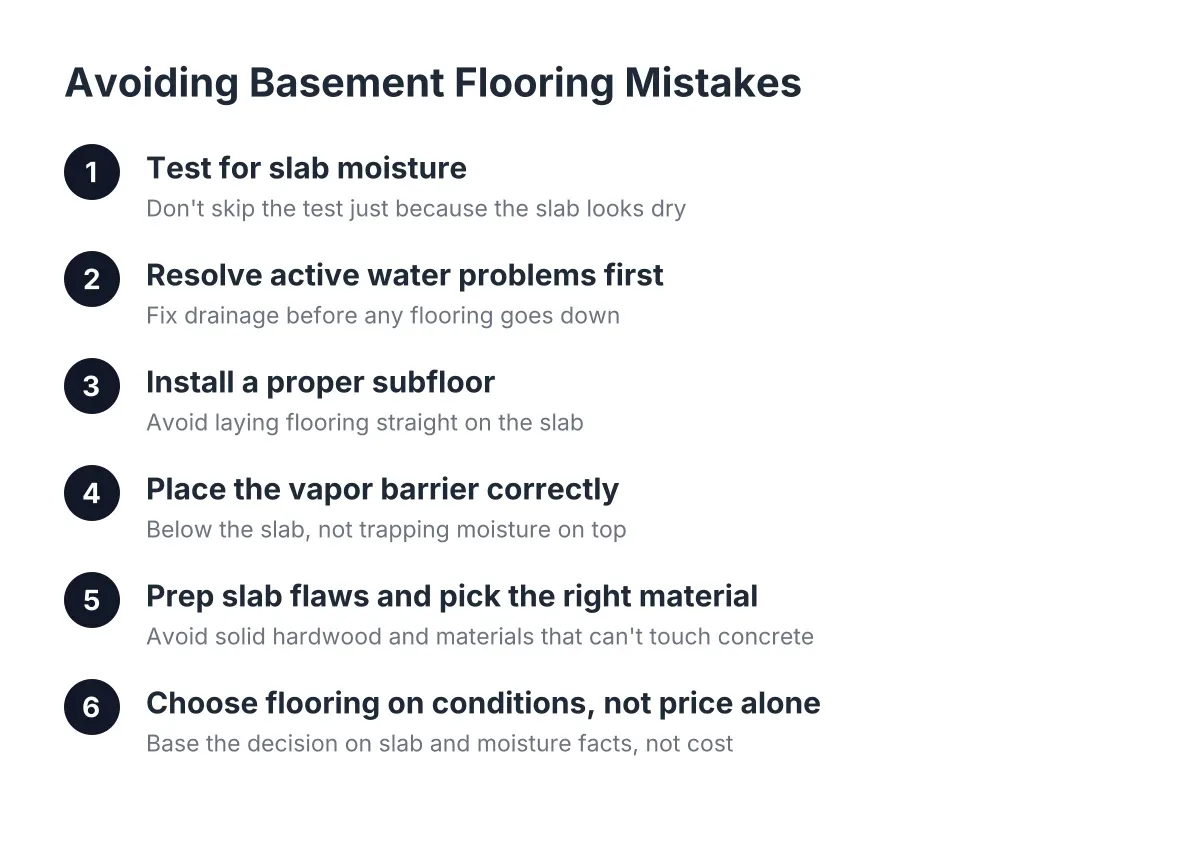
One thing up front: no flooring material fixes a wet basement. If water pools on the floor after heavy rain, that drainage problem gets solved first, before any finishing work starts. Flooring choices manage moisture vapor, humidity, and the occasional minor event. They do not replace waterproofing where it is genuinely needed. A contractor who skips that conversation and goes straight to samples is the same contractor who slapped carpet over your last problem.
Why High-Moisture Basements Demand the Right Wet Basement Flooring Materials
Most St. Louis basements sit on a concrete slab poured decades ago, often with no vapor barrier underneath. Concrete is porous. Vapor pressure pushes ground moisture through the slab year-round, even when the surface looks and feels dry. That vapor is what ruins flooring from below, long before you ever see standing water.
A vapor barrier placed over the base course under a concrete slab is meant to block moisture transmission from the ground into the concrete above, according to W. R. Meadows. Older homes rarely have one, and even newer slabs can transmit enough vapor to swell wood, delaminate glue-down products, and feed mold under carpet pad. That is why the material list below leans hard toward products that either tolerate vapor or sit above it on a protective subfloor.
With that context, here are the eight options, roughly ordered from most moisture-tolerant to least.
1. Luxury Vinyl Plank: The Default Pick for Damp Basements
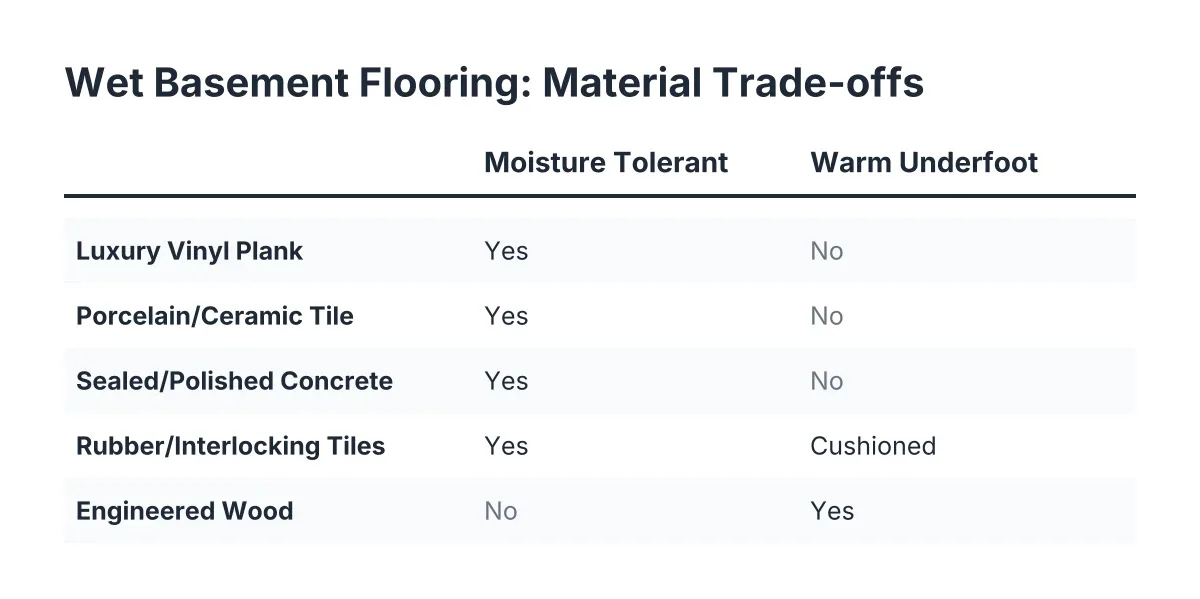
Luxury vinyl plank (LVP) is the material most contractors reach for first in a basement with known moisture history, and for good reason. It is waterproof through its full thickness, it resists humidity swings, and it does not cup, bow, or buckle the way solid or engineered wood can when the slab sends vapor upward. Click-lock LVP floats over the slab, so a minor water event means pulling planks, drying the area, and reinstalling, not tearing out the whole floor.
For a landlord turning over a rental in St. Louis city or Granite City, LVP also wins on tenant durability. It shrugs off dropped items, pet accidents, and mop water. The main trade-off is feel: over bare concrete it is hard and cold underfoot, which is why pairing it with a raised subfloor (item 7 below) matters in a space meant for living, not just passing through.
2. Porcelain or Ceramic Tile: Waterproof, but Cold Without Help
Tile is the one flooring that genuinely does not care about water. Porcelain in particular absorbs almost nothing, and a properly installed tile floor can take a minor flood and clean up with a mop. For a basement bathroom or the floor around a basement bar sink, tile is hard to beat.
The limitations are comfort and cost. Tile over a St. Louis slab stays cold most of the year unless you add heat beneath it, and installation labor runs higher than floating floors. Grout also needs sealing to stay mold-resistant in a humid lower level. Tile makes the most sense in wet zones, with warmer wet basement flooring materials in the main living area.
3. Sealed or Polished Concrete: Work With the Slab, Not Against It
Sometimes the smartest high-moisture answer is no flooring at all. Grinding, sealing, or polishing the existing slab removes the question of what moisture will ruin, because there is nothing above the concrete to ruin. Vapor passes through a breathable sealer without trapping water underneath.
This approach suits utility-heavy layouts, basement bar areas with an industrial look, and rental units where the owner wants near-zero flooring maintenance between tenants. The drawbacks are the same as tile: hard, cold, and unforgiving underfoot. Area rugs with washable, synthetic backing can soften specific zones without committing the whole floor to carpet.
4. Rubber or Interlocking Vinyl Tiles: Built for Gym and Workshop Zones
Rubber flooring and interlocking PVC tiles handle moisture well and add cushion that hard surfaces lack. Many interlocking products sit on raised feet or channels that let minor moisture move and dry beneath them instead of sitting trapped against the slab. They also come up in sections, which makes inspection and drying after a wet event straightforward.
However, these are zone products, not whole-basement finishes. They look right in a home gym, a kids' play corner, or a workshop, and wrong in a finished family room. Use them where function beats appearance and keep a more finished material elsewhere.
5. Engineered Wood: Possible, but Only Over a Proven-Dry Slab
Engineered wood tolerates basements better than solid hardwood because its cross-ply core resists seasonal movement. Solid hardwood should stay off the list entirely; below grade, it absorbs vapor, swells, and gaps no matter how careful the install. Engineered boards narrow that risk but do not remove it.
If a musty smell shows up after rain, or a past contractor's fix did not hold, engineered wood is a gamble you do not need to take. It belongs only over a slab that has passed moisture testing, with a vapor-rated underlayment or raised subfloor beneath it. Even then, one sustained wet event can mean replacement, where LVP would have survived. This is a case where the honest answer is often to choose the look-alike vinyl instead.
6. Carpet Tiles Over a Subfloor: Warmth Without the Mold Trap
Wall-to-wall carpet glued or stretched over bare concrete is the classic basement mistake, and if you have smelled musty carpet after a storm you know why. Carpet pad soaks up vapor and holds it against the slab, which is exactly the environment mold wants. That does not mean carpet is banned from basements; it means the installation has to change.
Carpet tiles with a moisture-resistant backing, installed over a raised plywood subfloor, give you warmth underfoot with an escape plan. A wet section comes up tile by tile, dries, and goes back down. For a basement bedroom or media room where bare LVP feels too hard, this is the safer way to get softness in a space with moisture history.
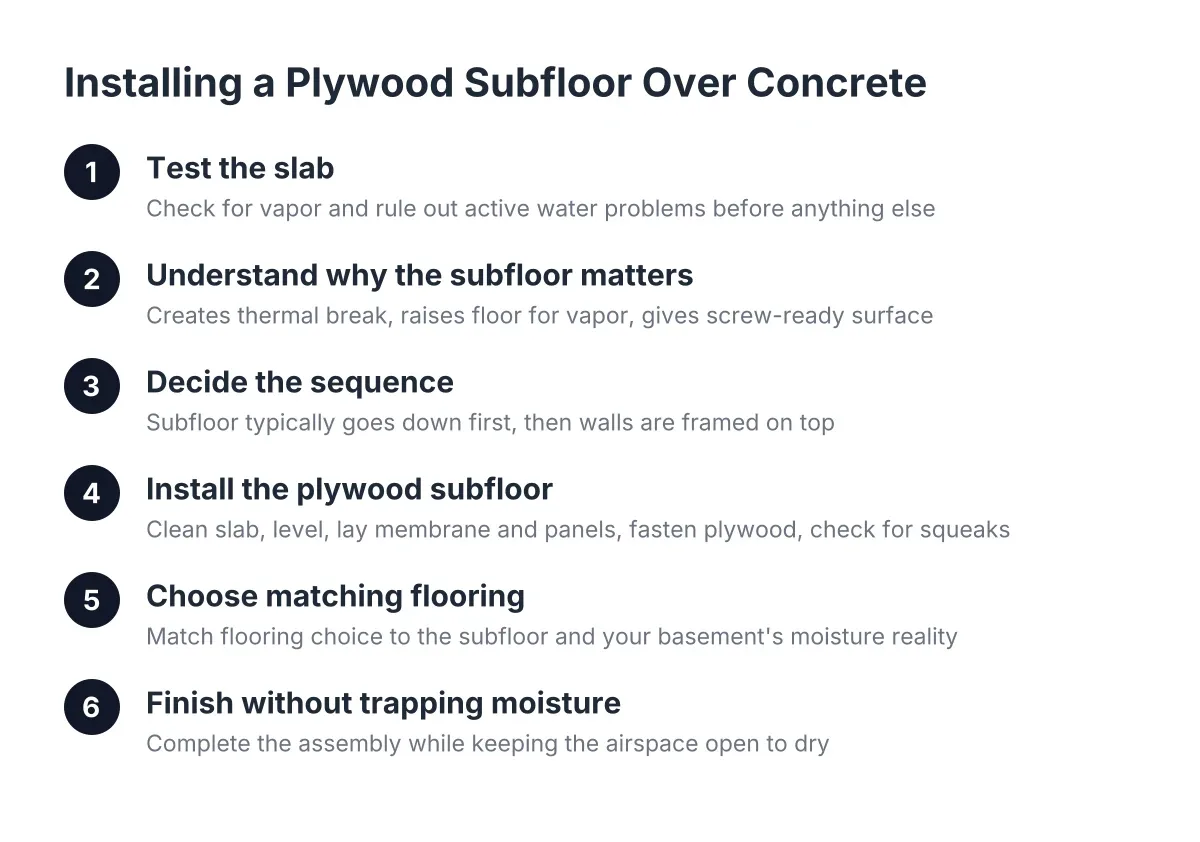
7. A Raised Subfloor System: The Layer That Makes Everything Above It Safer
A dimpled-membrane subfloor panel is not a finish floor, but in a high-moisture basement it may be the most important line item on the quote. The panels sit slightly off the concrete, creating an air gap where vapor can migrate toward drier zones and escape rather than accumulate under your finished floor. A plywood subfloor over that membrane then gives carpet, LVP, or engineered wood a stable, dry base.
Two points matter here. First, even a basement with a vapor barrier under the slab still benefits from a subfloor system, because it protects the finished floor from future moisture events, not just everyday vapor. Second, vapor barriers only help in the right location; a plastic sheet laid in the wrong place traps moisture against framing and accelerates the exact mold problem you are trying to prevent. This is a spot where a contractor who understands the full wall-and-floor assembly earns their fee, and where a quick DIY fix often fails.
8. Epoxy or Coating Systems: Durable, With One Big Caveat
Epoxy and similar coatings create a tough, cleanable surface that works well for rec rooms, laundry areas, and rental basements that take abuse. The caveat is moisture vapor. Coatings bond to the slab, so if vapor pressure is pushing up from below, the coating can blister and peel within a season. Treating only the surface without addressing the vapor driving through the concrete is why so many basement coatings fail early.
Before any coating goes down in a moisture-prone basement, the slab needs a moisture test, and high readings call for a vapor-mitigating primer or a different material altogether. Skip that step and you pay for the floor twice.
How to Choose Basement Flooring When Moisture Is the Main Risk
Match the material to the room's job and the slab's actual condition, not the showroom sample. A practical order of operations looks like this:
- Fix active water first. Standing water, grading problems, or gutter issues get solved before finishing starts, period.
- Test the slab. A moisture test tells you whether you are managing vapor or fighting liquid water, and the answer changes the material list.
- Decide on a subfloor. For most St. Louis basements with any moisture history, a raised subfloor under the living areas is the cheapest insurance on the job.
- Zone the materials. Tile or sealed concrete in the bathroom and bar area, LVP in the main room, carpet tiles over subfloor in the bedroom.
- Keep the assembly consistent. Pressure-treated bottom plates on framed walls, moisture-resistant board instead of standard drywall, and insulation that will not feed mold all work together with the floor.
For example, suppose a landlord buys a Fairmont City rental with a basement that took on water two springs ago. In that scenario, a sensible scope is grading and downspout correction outside, a slab moisture test inside, a dimpled subfloor with plywood over the main room, LVP throughout, and tile in the new basement bathroom. Nothing in that plan depends on hoping the basement stays dry; every layer assumes it eventually will not.
Budget plays into this too. When you compare basement flooring options on cost per square foot, remember that the subfloor and prep work are part of the real price, and a cheap floor over a wet slab is the most expensive floor you can buy. Permit requirements in St. Louis also come into play once you add framing, electrical, or a bathroom, so fold that into the plan rather than treating flooring as a standalone purchase.
The Bottom Line on High-Moisture Basement Floors
If your basement has ever been wet, the ranking is simple: LVP, tile, and sealed concrete are safe bets; rubber and carpet tiles work in the right zones over the right subfloor; engineered wood is conditional; solid hardwood and padded wall-to-wall carpet on bare concrete are off the table. The material matters, but the layers underneath it matter more.
A slab with serious or recurring water intrusion needs a professional assessment before any finishing decision, and sometimes the honest answer is to spend on drainage this year and flooring next year. That is a harder conversation than picking colors, but it is the one that keeps a finished basement finished.
If you need basement finishing, STL Basement Finishing can help.
Prefer to talk it through? Call (314) 916-6297 — a quick call is usually the fastest way to get a straight answer for your situation.