Basement Carpet Tiles: Peel-and-Stick Install, Stains, and Real Costs
Basement carpet tiles come up in almost every flooring conversation we have with St. Louis homeowners, usually right after someone asks whether regular carpet will survive on a concrete slab. The short version: carpet tiles handle basement conditions better than wall-to-wall broadloom, they install fast with peel-and-stick backing, and a stained or soaked square can be swapped instead of replaced wholesale. This FAQ walks through the questions budget-focused homeowners actually ask, grounded in the moisture and slab conditions common in St. Louis basements. Whether you typed in carpet tiles for basement floors or asked about a single basement carpet tile you can swap out later, the answers below apply.
Are Carpet Tiles Good for Basement Floors?
Carpet tiles are one of the better basement flooring choices for St. Louis homes because they tolerate concrete slab moisture, install without stretching or tack strips, and can be replaced one square at a time. For a basement used as a playroom or family space, they add warmth and comfort that hard flooring cannot match at the same price.
Most tiles built for below-grade use have a solid vinyl or polymer backing rather than the jute or woven backing on traditional carpet. That backing resists the low-level moisture vapor that migrates up through nearly every basement slab in the region, especially in older homes without a vapor barrier under the concrete. According to W. R. Meadows, a vapor barrier placed over the base course under a slab is meant to block moisture transmission from the ground into the concrete above; many St. Louis homes built decades ago never got one, which is exactly why the flooring you choose has to tolerate some vapor.
Carpet also does two practical things hard flooring does not. It softens falls, which matters if the space is a kids' play area, and it absorbs sound, so a finished basement does not echo like a gymnasium.
What Is the Best Carpet Tile for a Basement?
The best carpet tile in a basement is one built for below-grade use: a solid vinyl or polymer backing instead of jute, and solution-dyed synthetic fiber on top. The backing is what tolerates slab vapor, and the fiber is what shrugs off juice, mud, and pet accidents. Match the attachment style to your slab. On a flat, dry slab, peel-and-stick squares are the fastest and cheapest route. On a slab that runs damp, raised interlocking tiles that sit slightly off the concrete are the safer pick, because the air gap lets vapor escape instead of collecting against the backing.
How Do Peel-and-Stick Carpet Tiles Install Over Concrete?
Peel-and-stick carpet tiles install by cleaning the slab, snapping chalk lines from the center of the room, and pressing each tile down with its adhesive backing exposed. No tack strips, no stretching, no seaming iron. A competent DIYer can floor a 500 square foot basement room in a weekend.
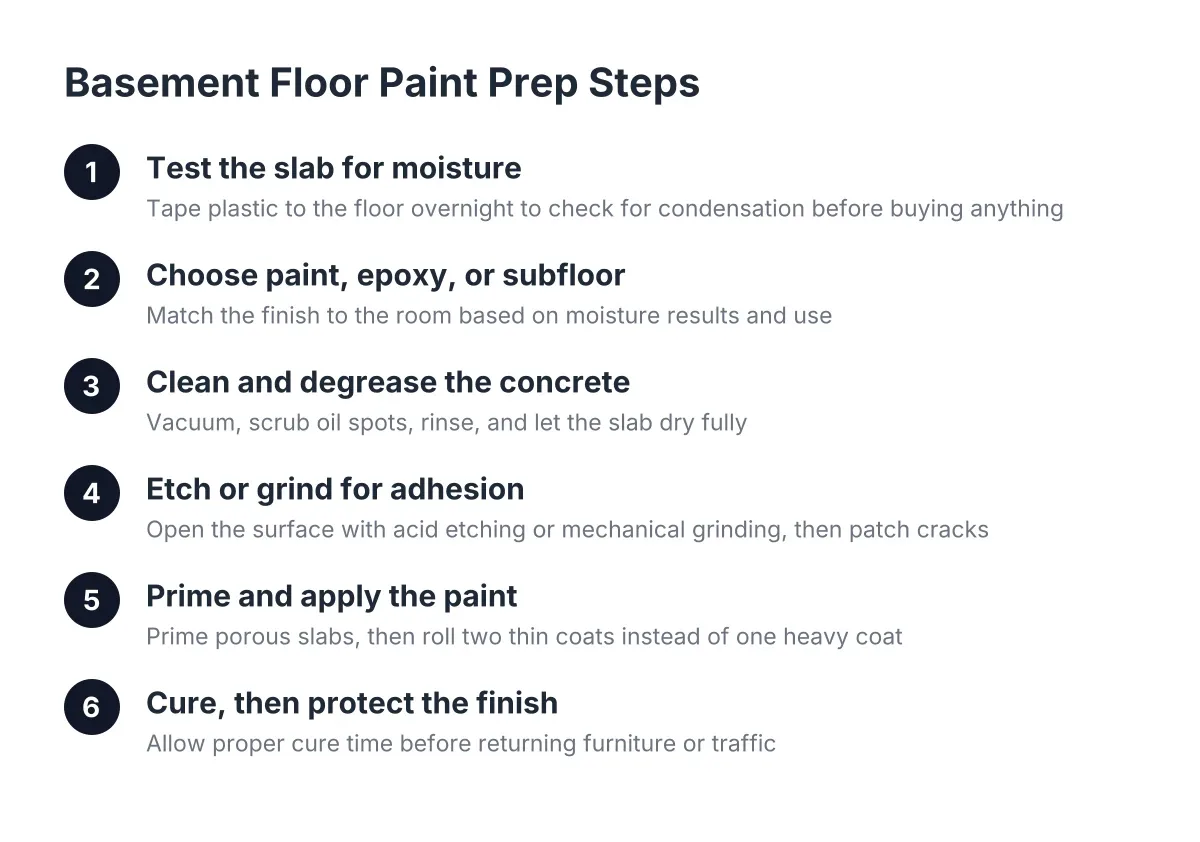
The catch is slab preparation. The concrete needs to be clean, dry at the surface, and reasonably flat. Paint splatter, efflorescence, and dust all weaken the adhesive bond. Low spots deeper than about a quarter inch over a few feet should be filled with a floor leveler first, or the tile edges will telegraph the dip.
There are three common attachment styles worth knowing:
- Peel-and-stick tiles with pressure-sensitive adhesive already on the back, the fastest option for a flat slab
- Loose-lay tiles held with double-sided tape or dots of adhesive at the perimeter, easier to lift later
- Interlocking carpet squares with raised plastic bases that snap together and sit slightly off the concrete, which also creates an air gap for vapor
That air gap matters more than most homeowners realize. A raised or dimpled base lets water vapor under the floor migrate toward drier zones and escape instead of accumulating against the carpet backing. It is the same principle behind dimpled subfloor panels used in full basement finishing projects.
Do Basement Carpet Tiles Need a Subfloor or Padding?
Basement carpet tiles do not require a subfloor; most are engineered to go directly over concrete. However, adding a subfloor or choosing tiles with padding built in makes the floor warmer and more comfortable, which matters in a St. Louis basement that sits below grade year-round.
Glue-down tiles on bare concrete will always feel firm and cool underfoot. If the room is a home office where you sit at a desk, that may not bother you. If it is a playroom where kids sit on the floor for hours, carpet squares with padding attached, or a plywood subfloor over rigid insulation, changes how the room feels in January.
In a full basement finishing project, rigid insulation is typically laid over the slab with staggered, offset joints, then covered with a plywood subfloor. That assembly provides a thermal break and a secondary capillary break before any flooring goes down. It costs more, and it raises the floor height, so check your headroom and the bottom stair riser before committing.
What Do Carpet Tiles Cost Compared to Other Basement Flooring?
Carpet tiles generally sit in the lower-to-middle band of basement flooring costs, above bare concrete treatments like epoxy floor paint and below luxury vinyl plank or tile. The tiles themselves are only part of the number; slab prep, subfloor work, and who does the labor move the total more than the material choice does.
We do not quote cost-per-square-foot figures in an article, because slab condition, moisture, layout, and prep vary too much from house to house to make a single number honest. What we can tell you is what drives the price up or down:
- Slab condition. A flat, dry slab needs almost no prep. A slab with low spots, old adhesive, or active moisture needs leveling or mitigation first.
- Tile construction. Basic peel-and-stick squares cost less than cushion-backed or raised interlocking tiles.
- Subfloor decisions. Skipping a subfloor keeps the budget lean; adding insulation and plywood adds material and labor but changes comfort.
- Labor. Carpet tiles are one of the few basement floors a homeowner can realistically install alone, which is a genuine budget lever, not a corner cut.
For comparison, vinyl basement flooring, especially LVP, costs more per square foot in material but resists standing water better. Carpet tiles cost less and feel better underfoot but need airflow to dry after a wetting event. Neither is wrong; they solve different problems.
How Do Carpet Tiles Handle Stains and Spills?
Carpet tiles handle stains better than wall-to-wall carpet for one simple reason: you can pull the stained square, scrub it in a utility sink, and set it back, or replace it entirely from a box of spares. Most basement-rated tiles also use solution-dyed synthetic fibers that resist juice, mud, and pet accidents.
Therefore, buy 10 to 15 percent extra when you order. Suppose a family in South County finishes their basement as a playroom, and two years in, a marker incident ruins three squares near the craft table. In that scenario, they lift three tiles, press in three spares from the closet, and the floor looks new for the cost of nothing. With broadloom carpet, that same incident means living with the stain or recarpeting the room.
One practical note on color: lighter flooring is generally easier to keep looking clean in a basement and brightens a space that gets little natural light. Mid-tone or lightly patterned squares hide everyday traffic well without going dark.
What Happens If Basement Carpet Tiles Get Wet?
Wet carpet tiles can usually be lifted individually, dried, and reinstalled, which is the single biggest advantage they hold over glued or stretched carpet in a basement. A minor water heater leak or a wet spring means pulling a section, running a fan, and putting the floor back together.
That said, carpet tiles are moisture-tolerant, not waterproof. Tiles marketed as "waterproof" typically mean the backing will not absorb water, not that the fiber stays dry. If your basement has taken standing water more than once, solve the water problem first; no flooring choice fixes drainage. That is a situation where a contractor or a waterproofing professional should look at grading, gutters, and the slab before you spend money on finishes.
Also plan the layout so tiles near the water heater, sump pit, and floor drain stay accessible. Many homeowners epoxy or paint the utility room floor instead, which contains dust and keeps carpet out of the one area most likely to see water.
Carpet Tiles vs. LVP vs. Hardwood in a Basement
For most St. Louis basements, the realistic contest is carpet tiles versus LVP; solid hardwood loses on moisture alone. LVP resists humidity and will not cup, bow, or buckle the way solid or engineered wood can below grade, while carpet tiles win on comfort, sound, and entry price.
Here is how the trade-offs shake out across common basement flooring options:
- Carpet tiles: lowest realistic install cost, warmest underfoot, best sound absorption, individual squares replaceable, but fibers hold water if flooded
- LVP: fully waterproof surface, easy to clean, good for a basement bar or basement bathroom transition zone, harder and colder without area rugs
- Ceramic tile: nearly indestructible and waterproof, but cold, hard, and the most labor-intensive to install over concrete
- Solid hardwood: not recommended below grade; slab moisture and St. Louis humidity swings make movement and buckling a real risk
A practical middle path many families choose: LVP or tile in the bar and bathroom areas, carpet tiles in the play and TV areas. Mixing materials by zone costs little extra and puts each floor where it performs best.
Do I Need a Permit to Install Basement Carpet Tiles?
Installing carpet tiles by themselves does not typically trigger a permit; flooring is a finish material, not structural or mechanical work. However, if the flooring is part of a larger basement finishing project involving framing, electrical, plumbing, or a new basement bathroom, that broader project does need permits in St. Louis area jurisdictions.
Permit requirements and fees vary by municipality, so confirm with your local building department or let your contractor handle the filings. The flooring itself is usually the easy part of the paperwork. The framing around a load-bearing wall, the wiring, and the plumbing are what inspectors care about.
The Bottom Line for Budget-Focused Homeowners
Basement carpet tiles are the strongest option when the priority is a warm, kid-friendly floor at the lowest defensible cost, on a slab that stays dry most of the time. Choose peel-and-stick or loose-lay tiles for a flat, dry slab. Step up to raised interlocking tiles or a proper subfloor if your slab runs damp or you want more warmth. Order spares, keep carpet out of the utility room, and fix any active water problem before the first tile goes down. Get those decisions right and the floor will be the least surprising line item in the whole project.
If you need basement finishing, STL Basement Finishing can help.
Related guide: basement flooring options — Complete Guide
Prefer to talk it through? Call (314) 916-6297 — a quick call is usually the fastest way to get a straight answer for your situation.