Electric Baseboard Heaters vs. Mini-Splits for a Finished Basement in St. Louis, MO
A finished basement that stays cold half the year is a finished basement nobody uses. If you are planning a basement finishing project in St. Louis, MO, the heating decision usually comes down to two practical options: electric baseboard heaters versus mini-splits, or baseboard heaters vs mini-splits. Both can keep a lower level comfortable through a Missouri January, but they differ in installation cost, operating cost, permitting, and how they fit the rest of your basement remodeling scope. This article walks through seven specific points of comparison so you can choose with your eyes open, instead of discovering in February that your new playroom sits at 61 degrees.
One note before the list. Everything here assumes the heating choice gets made during planning, not after drywall. Suppose a homeowner in South County finishes a 700 square foot basement into a playroom and guest bedroom, then realizes the space runs cold. In that scenario, adding heat after the fact means opening finished walls, rerunning electrical, and paying for drywall repair twice. Deciding between baseboard heat and a mini-split before framing starts is the cheapest version of this decision you will ever get.
1. Understand How Electric Baseboard Heaters and Mini-Splits Actually Work
Electric baseboard heaters are resistance heaters: electricity runs through an element, the element gets hot, and the warm air rises off the unit along the wall. There are no ducts, no refrigerant lines, and no outdoor equipment. A mini-split works differently. It is a small heat pump with an outdoor compressor and one or more indoor wall units, moving heat rather than generating it from scratch.
That difference matters for a basement. Baseboard units heat the room they sit in and nothing else, which makes them a natural fit for a single space like a basement bathroom or home office. A mini-split can condition a larger open area, and it cools in summer too, which baseboard heat cannot do. For a St. Louis basement that runs humid in July, that cooling and dehumidification side is worth real consideration.
2. Compare Installation Scope: Baseboards Are Simple, Mini-Splits Are a Project
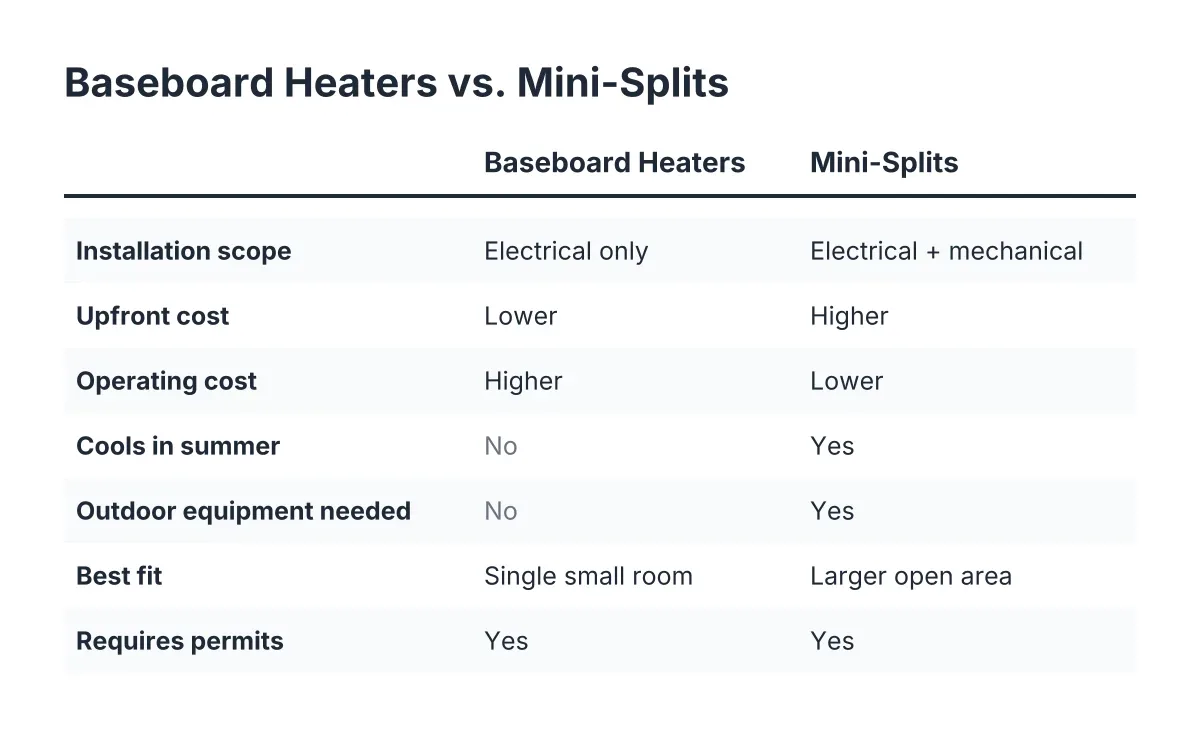
Installing electric baseboard heaters in a mini basement office or guest room is one of the lighter line items in a basement finishing budget. The work is mostly electrical: a dedicated circuit from the panel, wiring in the stud wall before drywall, and mounting the unit on the finished wall. Smaller units can run on an electric baseboard heater 110 volt circuit, while larger rooms usually call for 240 volt units, which an electrician sizes during the planning stage.
A mini-split involves more trades and more steps. The outdoor compressor needs a pad or bracket, refrigerant lines run through the rim joist or wall, a condensate drain has to go somewhere sensible, and the indoor head mounts high on a wall. None of that is exotic, but it is a mechanical installation, not just an electrical one. Either way, hire a licensed electrician for the circuit work and an HVAC contractor for the refrigerant side; these are not DIY trades even for homeowners comfortable with framing and drywall.
3. Do Electric Baseboard Heaters Use a Lot of Electricity?
Electric baseboard heaters use more electricity per unit of heat than a mini-split, because resistance heat converts electricity to warmth at a one-to-one rate while a heat pump moves several units of heat for each unit of electricity it consumes. For a small room heated occasionally, that gap barely shows up on a bill. For a large basement heated daily, it adds up every month.
This is the core trade-off of the whole comparison. Baseboard heat is cheap to install and more expensive to run. A mini-split costs more upfront and less to operate, especially across a full heating season. Therefore, the right answer depends on square footage and usage. A guest bedroom used a dozen weekends a year favors baseboards. A 900 square foot family room where the kids live every evening favors the mini-split, because the operating savings compound over years of daily use.
As an illustrative estimate only, many homeowners find that mini baseboard units in a single small room cost a few hundred dollars in equipment plus the electrician's circuit work, while a single-zone mini-split lands in the low thousands installed. Your actual numbers depend on panel capacity, run lengths, and room sizes, which is why a written scope beats any online figure.
4. Permits: What the Permit-Anxious Homeowner Should Expect
Both options trigger permits as part of a basement finish in St. Louis, and that is a good thing, not a delay to dodge. Electric baseboard heaters fall under the electrical permit for the project, since they require new dedicated circuits inspected at rough-in. A mini-split typically involves both electrical work and mechanical work, so expect the HVAC contractor to handle the mechanical side of the paperwork.
If a contractor tells you new heating circuits in a basement finish do not need inspection, treat that as a warning sign, not a convenience. Unpermitted electrical and mechanical work is exactly the kind of thing that surfaces during a home sale, when a buyer's inspector asks whether the basement finish was permitted. Basement finishing projects normally include an electrical rough-in inspection before insulation goes in, and heating circuits are part of what the inspector looks at. A contractor who pulls the permits and schedules those inspections is taking the risk off your plate, which is where it belongs.
City of St. Louis and St. Louis County run separate permitting offices with their own processes, so confirm which jurisdiction your home falls under before anyone starts work. Your contractor should know this without being asked.
5. Match the System to Your Basement Layout, Not the Other Way Around
Basement layout drives this decision more than brand comparisons do. A mini-split head mounted on one wall conditions open space well, but it does not push heat around corners into a closed basement bathroom or down a hallway to a guest room. Closed rooms behind doors need their own heat source, and that is where small electric baseboard units earn their keep even in a mini-split basement.
For example, a common hybrid setup in a St. Louis basement finish looks like this:
- One mini-split head serving the main open family room or basement bar area
- A compact electric baseboard heater, mini sized for the room, in the basement bathroom
- A second small baseboard unit in a closed guest bedroom or office
- Individual thermostats on each baseboard so unused rooms stay turned down
This hybrid approach also gives you room-by-room control without the cost of a multi-zone mini-split. The bathroom stays warm on winter mornings, the guest room only draws power when someone visits, and the main space gets efficient heating and summer cooling from the heat pump.
6. Factor In the Rest of the Basement Envelope First
No heating system overcomes a cold concrete box. Before sizing either system, the basement envelope needs attention: rigid foam insulation against the foundation walls acts as a thermal break and keeps temperatures stable, and a proper plywood subfloor over the slab keeps finished flooring from feeling like ice. Rigid insulation on the floor, installed with staggered joints over the slab, adds both a thermal break and a secondary moisture barrier under the subfloor.
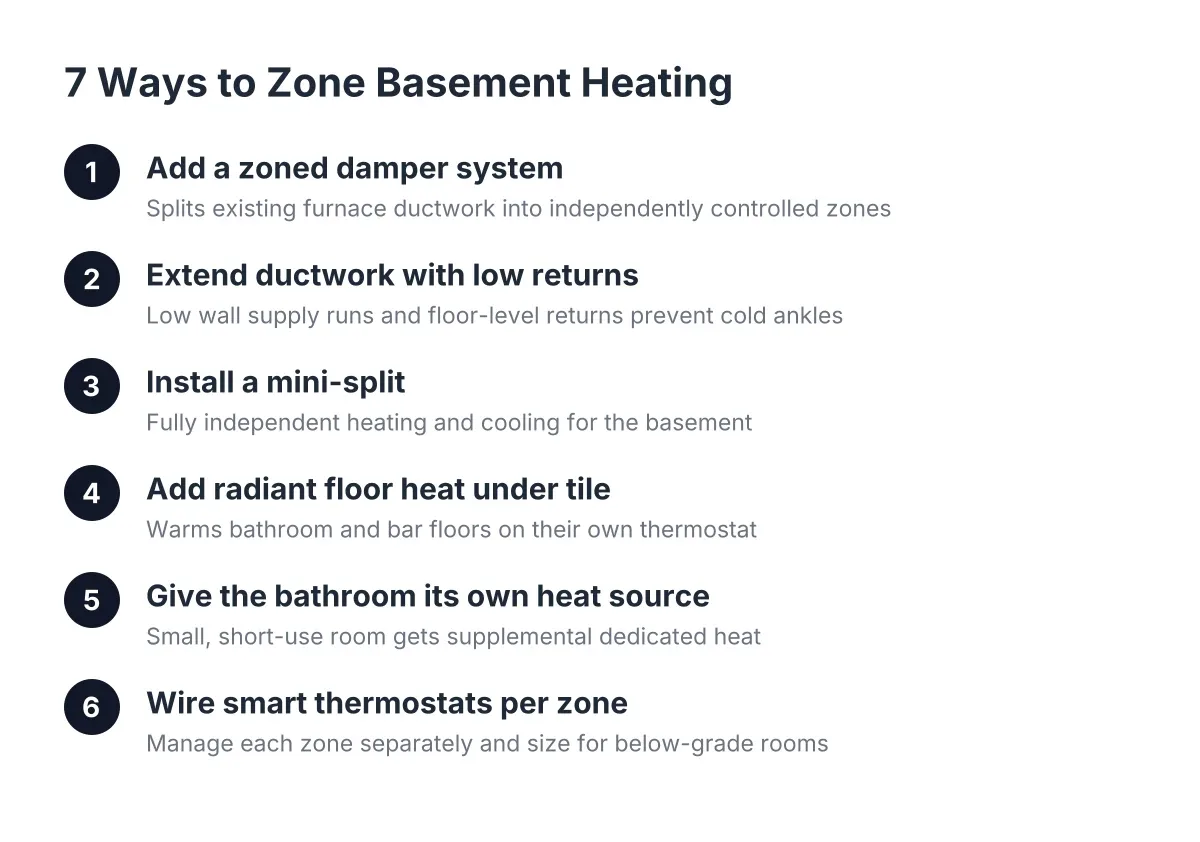
This matters for cost because an insulated basement needs a smaller heating system. A well-sealed, insulated lower level in St. Louis might get by with modest baseboard capacity where an uninsulated one would demand an oversized mini-split running constantly. In addition, if your finish plan includes relocating ductwork or boxing ducts for ceiling height, that work happens in the same planning window, so get the whole heating and envelope conversation settled before framing. Some basements with easy ductwork access do better extending the existing furnace system instead of adding either option here; an HVAC contractor can tell you quickly whether your trunk lines have the capacity.
7. How Long Do Electric Baseboard Heaters and Mini-Splits Last?
Electric baseboard heaters commonly outlast most other basement heating systems because they have no moving parts; a quality unit can run for a couple of decades with little more than occasional cleaning. Mini-splits are mechanical equipment with compressors, fans, and refrigerant, so they need periodic service and have a service life closer to other heat pump equipment.
Maintenance is the quiet advantage of baseboard heat. There are no filters to change, no condensate drains to clear, and no refrigerant to check. The honest trade-off is comfort range: baseboards only heat, so a basement that gets sticky in a Missouri summer still needs a dehumidifier or separate cooling, while the mini-split handles both seasons with one system. Weigh lifespan and upkeep against that year-round capability when you compare total cost of ownership rather than just the install quote.
8. The Decision in Plain Terms
Here is the short version for a growing family finishing a basement in St. Louis, MO. Choose electric baseboard heaters when the heated space is small, closed, or used part-time: a bathroom, a guest bedroom, or a compact office. Choose a mini-split when you are finishing a large open area the family will use daily, when summer cooling matters, or when monthly operating cost over ten-plus years outweighs the higher install price.
Many finished basements end up with both, and that is not indecision; it is matching the tool to the room. Whichever direction you lean, insist on a written scope that names the equipment, the circuits, the permits to be pulled, and the inspections to be scheduled. If a bid is vague on permits, the price is not the real price. A basement that is warm, legal, and documented is the one that adds value when you sell, and the one your family actually uses in January.
A final caution: heat load calculations, panel capacity, and jurisdiction-specific permit requirements vary house to house, so have a licensed electrician and HVAC contractor confirm sizing and code requirements for your specific basement before you commit to either system.
If you need basement finishing, STL Basement Finishing can help.
Prefer to talk it through? Call (314) 916-6297 — a quick call is usually the fastest way to get a straight answer for your situation.