Basement Finishing Contractor vs. General Contractor: Who Should You Hire in St. Louis?
If you are planning to finish your basement in St. Louis, one of the first decisions you will face is whether to hire a basement contractor versus a general contractor: do you hire a specialist who works below grade every day, or a general contractor who handles all kinds of remodeling? The answer matters more for basements than for almost any other project in the house. Basements bring moisture, concrete, low ceilings, mechanical systems, and code questions that a kitchen or bathroom remodel never touches. This is doubly true if you are converting your basement into a rentable suite or in-law apartment, where "finished" and "legally livable" are two different standards.
Here are seven points of comparison to help you decide which kind of contractor fits your project, your budget, and your goals.
1. Know What Each Type of Contractor Actually Does
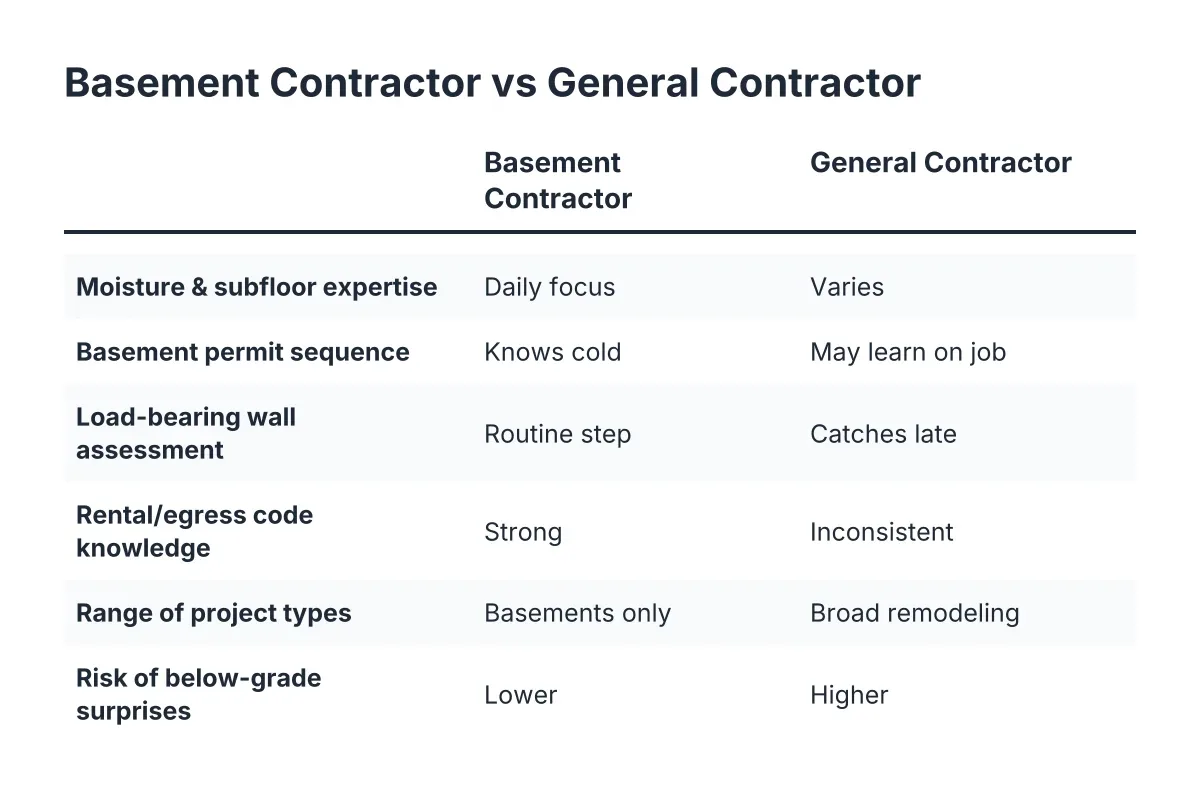
A basement finishing contractor focuses on one thing: turning unfinished lower levels into livable space. That means framing against foundation walls, managing moisture, choosing the right subfloor, running heating into a space the original HVAC system may not reach, and handling the permit process for below-grade work. A general contractor manages a broader range of projects, from decks to kitchens, and may subcontract the basement-specific pieces to others.
Neither option is wrong by default. However, the choice between a basement contractor and a general contractor comes down to repetition. A specialist has seen your exact situation, a 1960s St. Louis ranch with a damp slab and a load-bearing beam cutting the space in half, dozens of times. A generalist may be solving it for the first time on your dime.
2. Compare How Each Handles Moisture, Subfloors, and Concrete
Basements fail at the floor and the walls, not the drywall. Moisture moves up through concrete slabs from the ground below, which is why a vapor barrier placed over the base course under a slab exists to block that moisture from reaching the concrete above, according to W. R. Meadows. A contractor who finishes basements every week builds around this reality: plywood subfloor systems that keep finished flooring off the slab, flooring choices that tolerate humidity, and wall assemblies that do not trap water against the foundation.
For example, the carpet versus hardwood decision in a basement is not a style question first; it is a moisture question. A basement specialist will test and assess before recommending, while a generalist may default to whatever worked upstairs. Ask any contractor you interview how they handle subfloor installation over concrete. A vague answer is a warning sign.
3. Weigh Permit and Code Knowledge, Especially for Rental Conversions
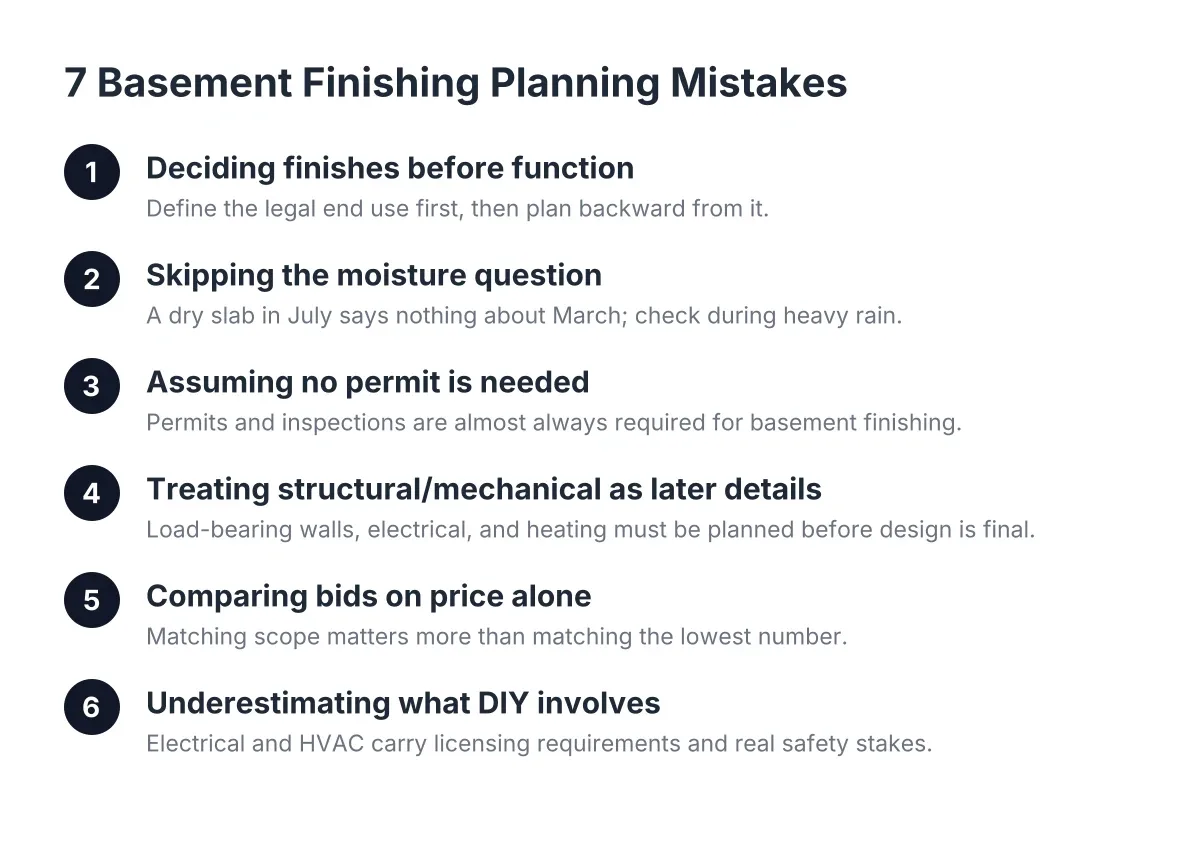
This is where the stakes rise for anyone converting a basement into an income unit or in-law suite. "Do I need a permit" is the question every homeowner asks, and the answer for a basement finish in St. Louis is almost always yes once you touch framing, electrical, or plumbing. Finished and legally livable are not the same thing. A legal basement living space involves egress requirements for any bedroom, ceiling height minimums, and proper heating, and a rental unit can raise zoning questions a standard finish never triggers.
Expect multiple inspections along the way, not one. Basement projects commonly require an electrical rough-in inspection early, followed later by a separate insulation inspection, before drywall ever goes up. A contractor who pulls basement permits regularly in St. Louis MO knows this sequence cold and schedules around it. A generalist who rarely works below grade may learn the local sequence on your project, which shows up as delays and re-inspections.
One honest caveat: no contractor can tell you whether your specific property is zoned for a separate rental unit. For a basement apartment conversion, confirm zoning with the city before you spend money on design.
4. Look at Structural Experience With Load-Bearing Walls and Beams
Nearly every basement layout decision collides with structure. The beam running down the middle of your basement, the posts holding it up, and any wall you want to move or open may be load-bearing. A basement finishing contractor deals with load-bearing wall assessment and framing as a routine part of scoping the job, because the layout of a basement bar, bathroom, or bedroom has to work around what holds the house up.
Suppose a homeowner in South County wants to turn a 900-square-foot unfinished basement into a one-bedroom in-law suite. In that scenario, the bedroom needs an egress window, the bathroom needs to sit near the existing drain stack to control plumbing cost, and a support post lands exactly where the living area should open up. A specialist works through those three constraints in the first site visit. A generalist may not catch the conflict until framing starts, and that is where budgets balloon.
5. Understand Where the Money Goes Before You Compare Bids
Nobody can quote your basement over the phone, and you should be skeptical of anyone who tries. What a good contractor can do is explain the factors that drive cost per square foot so you can compare bids on equal terms. The big movers are consistent:
- Bathroom and kitchenette plumbing, especially if the slab needs cutting to reach drain lines
- Egress windows, which involve excavation and foundation cutting for a legal bedroom
- Heating, since many St. Louis basements need dedicated heat rather than a vent stolen from upstairs
- Subfloor and flooring choices, where a plywood subfloor adds cost but protects everything above it
- Trim and finish work, which homeowners consistently underestimate; a finished basement carries far more baseboard, casing, and paneling than a typical room
- Structural changes, any time a load-bearing wall or beam gets modified
When you ask how much it costs to finish a basement, a trustworthy answer walks through these factors against your actual space. Whether you are comparing basement renovation contractors or a general remodeler, insist that every bid itemizes these line items the same way. That is the only way to know whether a lower bid is efficiency or missing scope.
6. Decide What You Can DIY and Where a Pro Is Non-Negotiable
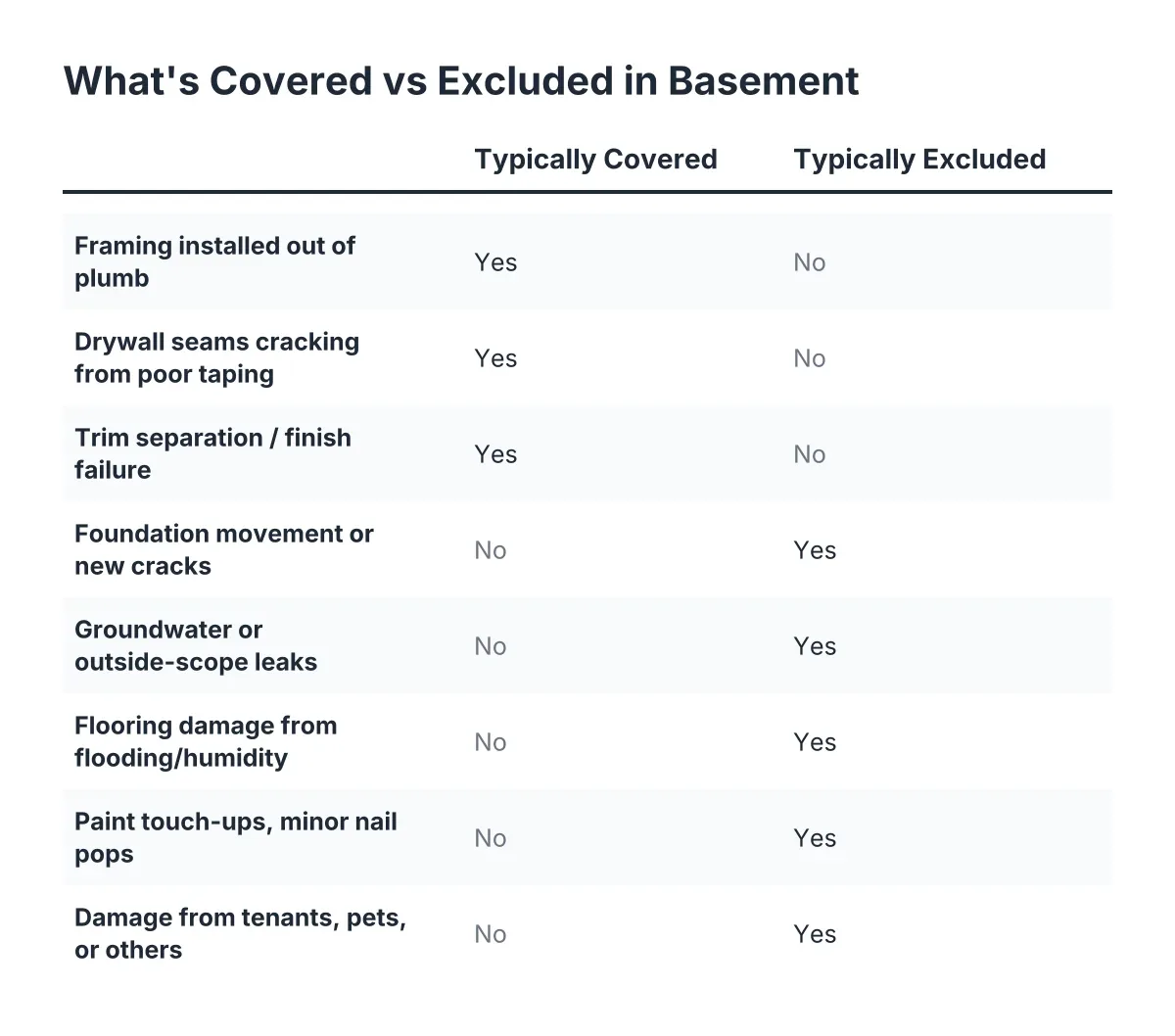
Basements are a forgiving place to learn carpentry. Cosmetic imperfections hide well below grade, and a motivated homeowner with a miter saw, a circular saw, and an impact driver for concrete fasteners can handle demolition, some framing, painting, and trim. If your budget is tight, a hybrid approach, where you do finish work and a contractor handles the core build, can be reasonable.
However, two trades should stay off your DIY list: electrical and HVAC. Experienced remodelers routinely draw this line even for capable DIYers, because both require licensing and carry real safety consequences. Basement wiring has its own code considerations too; running non-metallic cable inside EMT conduit is against code in damp or wet locations under the National Electrical Code (NFPA 70), and damp is the default condition in many St. Louis basements. Anything structural, anything touching a load-bearing wall, and anything behind a rental permit also belongs with a professional.
7. Ask Three Questions Before You Sign With Anyone
Whether you are searching for the best basement finishing companies near me or interviewing a general remodeler your neighbor used, the evaluation comes down to a short list. Ask every candidate these three questions:
- How many basements have you finished in the last two years, and can I see one? Volume in basement work specifically, not remodeling generally, is what you are buying.
- Who pulls the permit, and what inspections will this project require? The right answer names the inspection sequence without hesitation. If the contractor suggests skipping permits, walk away; an unpermitted finish can sink a future rental or home sale.
- What does your bid include, and what is excluded? A fair quote itemizes framing, electrical, plumbing, HVAC, subfloor, flooring, drywall, and trim, and states plainly what triggers a change order.
How long does it take a contractor to finish a basement? The honest answer depends on scope, permit review, inspection scheduling, and whether plumbing or egress work is involved, so compare contractors on how clearly they explain their schedule rather than on who promises the fastest date.
When the Basement Contractor Outperforms a General Contractor
For most St. Louis homeowners, the specialist is the stronger choice when the project involves moisture management, a basement bathroom addition, egress windows, structural changes, or a conversion to legal living space. Those are exactly the areas where below-grade experience prevents expensive surprises. A rental conversion in particular rewards a contractor who already knows what inspectors look for in a basement bedroom and bathroom.
When a General Contractor Makes Sense
A generalist can be a fine choice for a dry, simple basement with no plumbing, no structural changes, and no rental ambitions, especially if that contractor has already done good work on your house. The project risk is lower, so specialized experience matters less. Just hold them to the same permit and itemization standards you would hold anyone else.
The Bottom Line for St. Louis Homeowners
The decision between a basement contractor and general contractor is really a risk decision. The more your project involves water, structure, plumbing, or legal-living-space requirements, the more a basement specialist earns their place. One more trade-off worth naming honestly: basements rarely return their full cost at resale unless the finish is done thoroughly and well, so a rental conversion or a genuinely needed family space is usually a sounder reason to build than resale value alone.
If you are weighing basement remodeling in St. Louis, whether that is a playroom for a growing family or a full in-law suite with a bathroom and kitchenette, start with a site visit and a written, itemized estimate. Reach out to discuss your basement, your budget, and what it will take to get from bare concrete to finished, permitted living space with no surprises along the way.
If you need basement finishing, STL Basement Finishing can help.
Prefer to talk it through? Call (314) 916-6297 — a quick call is usually the fastest way to get a straight answer for your situation.